So when all taxis get into Belfast bus lanes from January 2015, exactly how many vehicles will be jostling with bicycles and buses?

In 2013 a high-profile campaign and street protest tried to stop the plan to increase the number of taxis allowed in Belfast bus lanes from 500 to a scary 2,000. When the arguments died down questions emerged about the official figures, suggesting a gross underestimation. A media exposé confirmed something was amiss, and the issue reached the Northern Ireland Assembly. And then, when all went quiet, things got really interesting..

Only half the story..

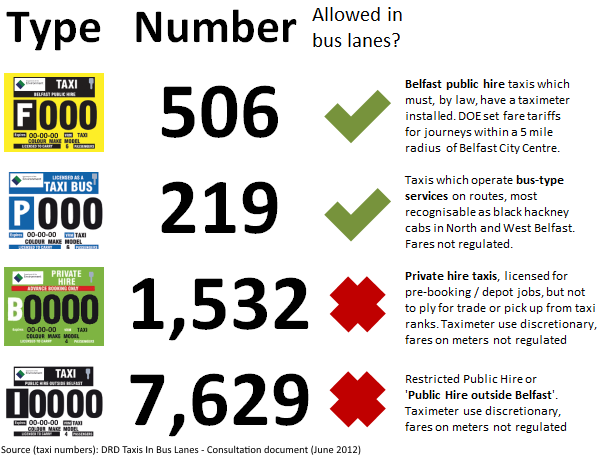
The Department for Regional Development (DRD) consultation on allowing taxis into bus lanes ran during the late summer of 2012. It included figures sourced from the Department of the Environment (DOE) on the number of taxis in Northern Ireland (shown with explanations in Fightback | Taxis in bus lanes). The consultation was pitched as a Northern Ireland-wide issue, but it was effectively a highly-focused Belfast-based policy change, with 99% of Northern Ireland’s bus lanes located in the Greater Belfast area.

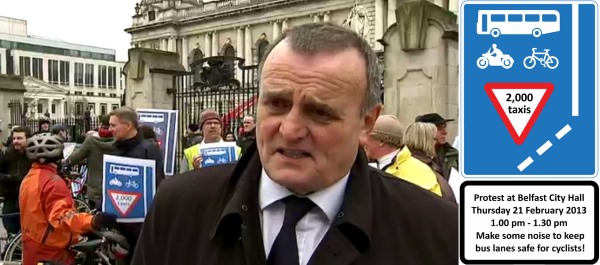
This meant an accurate assessment of the number of taxis in Belfast, and their concentrated impact on bus lanes, was crucial. The Belfast City Hall protest figure of 2,000 taxis was reached by adding 506 yellow plates and 1,532 green plates together, as presented in the consultation. It was known to be a conservative estimate, as many of the 219 taxi buses were likely to operate in Belfast too.
TMcC
The late Tom McClelland leading the protest against 2,000 taxis in bus lanes

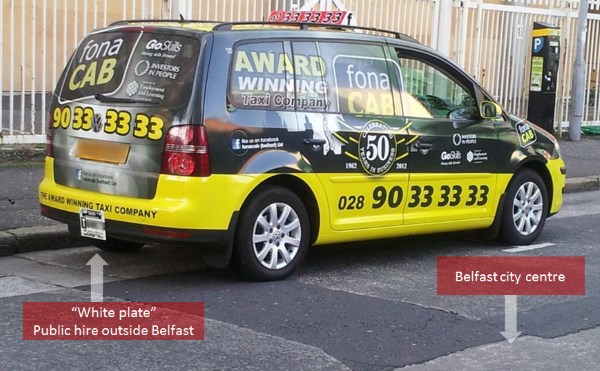
The 7,629 ‘white plate’ licence taxis operated as Public Hire Outside Belfast, so were naturally discounted. In case there was any doubt, DRD officials had erased it in front of the Regional Development Committee on 28th November 2012:

Seán Lynch MLA: “What additional volume of private taxis using bus lanes will this proposal bring about, and what impact will it actually have on buses?”

DRD official: “Well, the numbers that were identified in the consultation document in March 2012 [repeat of consultation numbers 1,532, 506, 7,629, 219] .. if you look at total volumes of traffic on the road, those are relatively small numbers. Obviously Belfast [sic] Public Hire Outside Belfast will not generally be in the Belfast area. So the numbers .. there’ll not be a huge influx of additional traffic into the bus lanes. The number of taxis may rise by, those figures may rise by 3 times the number of taxis that we have, but that will not have a significant, should not have a significant impact on any one bus lane or any one location.”

Seán Lynch MLA: “Just, I would say that is a fairly significant increase.”

DRD official (later): “I don’t think there’ll be a significant jump in the numbers that are using the lanes, and I don’t think it will have a, hopefully not a, significant impact on cyclists.”

2,000 then, give or take a few.

The phantom fleet..

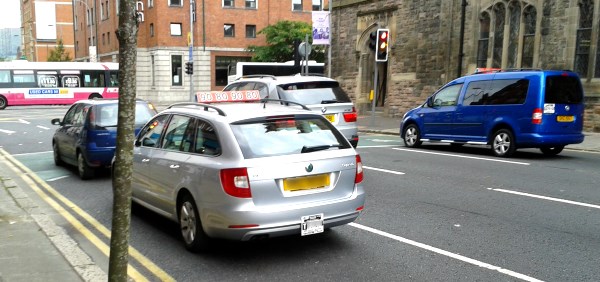
However in the aftermath of the protest, sources within the taxi industry began to question our figures. It was claimed that the “there are around 4,000 private hire vehicles in Belfast”, with more than 2,000 taxis working in the city while licensed as ‘white plates’.

WhitePlate

It’s important to note that it’s perfectly legal to operate within Belfast using a white plate licensed taxi, and there is absolutely no deception at work here – sources indicated it was simply down to the way taxis were licensed. It’s not even particularly problematic, save that it masks a potentially brutal impact on bus lanes.
2plates

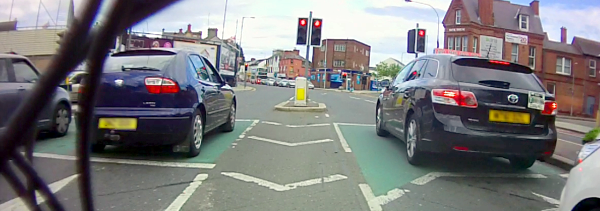
Being wary of the unique competing interests of the fractured Belfast taxi lobbies (hundreds of taxis drivers who are already permitted in bus lanes actually support  the cycling campaign) caution and evidence was needed. Could this claim really be true?
Cyclebox

Pennies started to drop looking at the population spread in Northern Ireland. According to the figures gleaned from the DRD consultation, just one fifth of the total NI taxi fleet operated in Belfast, yet the population of the Belfast Metropolitan Area (where all the bus lanes are) was over one third of total population of Northern Ireland. My inner ‘sixth form economics pupil’ began to scream “supply and demand” at this point.

taxi1

15 taxis for every Metro bus?

To get to the bottom of the issue, a provocative graphic was created to give a new perspective. Although buses clearly move the most people in this bus lanes, it was remarkable to many that bicycles vastly outnumbered all other vehicles.

The taxi figure of 4,500 was produced by adding 3 taxis categories together (green plate, yellow plate and white/blue taxi bus plate) along with 2,000 white plate taxis, and generously rounded. It left 2 crucial questions hanging – was this the actual number of taxis scuttling about Belfast’s streets, and (if so) should taxis be allowed to utterly dominate bus lanes?
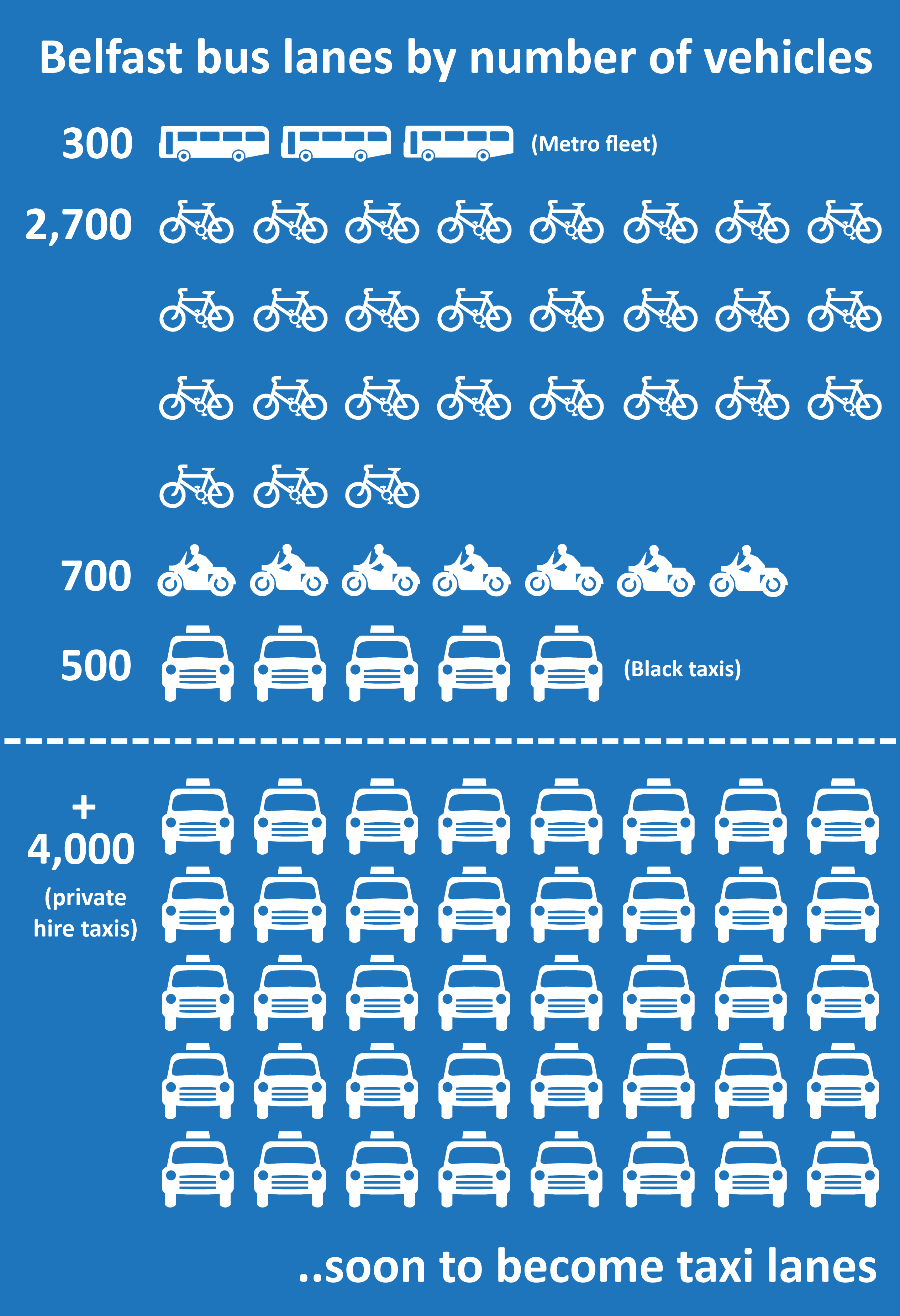
fleets

The reaction was swift and seemingly decisive. Linda Stewart of the Belfast Telegraph spent an enlightening hour counting taxis passing by St. Anne’s Cathedral, noting their licence plate colour. She observed that a majority of taxis were white plates (51 out of 79) putting DRD’s assessment of taxi numbers in question. Had the consultation exercise left everyone to comment on an unrealistic estimate?

David McNarry of the Regional Development Committee picked up on the numbers issue and, along with Sustrans and others, brought it to the attention of the Minister. One Departmental response, seen by NI Greenways, directly challenged the claims:

“The headline figure of 4,500 appears to be based on a fairly rudimentary calculation .. with an approximation of the numbers of white plated .. the origin of which is unknown .. the use of the estimated ‘white plate’ figure is questionable”.

Enter McCausland..

In a remarkable twist, the owners of the “Big Two” Belfast taxi firms, William McCausland of fonaCAB and Stephen McCausland of Value Cabs unexpectedly entered the fray. The two firms (in fierce competition with each other remember) penned a joint letter to the Regional Development Committee:

“We are aware of recent press interest in this and wanted to clarify for you some inaccurate information that has been published in some media outlets.

In particular, a suggestion has been made that figures put forward in the consultation by the Department in relation to the increased numbers of taxis which would operate in bus lanes have been underestimated and are incorrect.

We firmly believe that this is not the case and that, instead, the figures reported in the press are inaccurate and indeed, wholly unrealistic.

One article reported that as many as 4,500 taxis would be using bus lanes in Belfast, which includes “2,500 white-plate private hire taxis”.

This is incorrect.”

Why this curious intervention by the Big Two? This was an argument between cycle campaigners and DRD over data supplied by DOE. It was a simple case of mathematics – you can’t lobby away an objective measure. But this is Northern Ireland, so anything is possible..
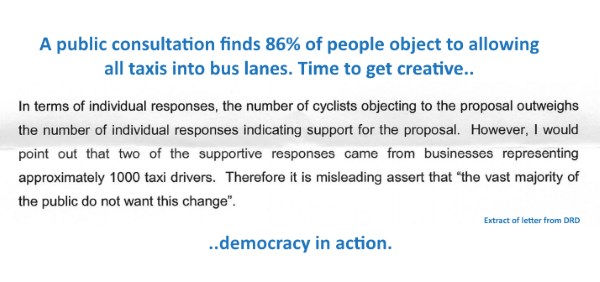
DRDquote

Value Cabs and fonaCAB (while massive companies) don’t represent the entire taxi sector in Northern Ireland. So how could they possibly know the total number of taxis in Belfast, especially if (as was becoming clear) the statutory licensing body wasn’t entirely sure?

Was a suggestion of 4,500 taxis that much of a game-changer for public and political opinion that the private hire taxi lobby felt compelled to intervene?

And then suddenly, just as cycling campaigners prepared to get stuck in to the issue, everything changed. Taxi reform was halted in June 2013 and the spectre of 4,500 taxis in bus lanes disappeared from view. The debate over the size of the taxi fleet passed out of public knowledge as quickly as it has risen..

“And some things that should not have been forgotten were lost.” (Tolkien)

Numberwang..

Fast forward to today and with taxi access seemingly inevitable by January 2015, this thorny issue remains largely unknown and unresolved. How many taxis actually operate in the greater Belfast area?

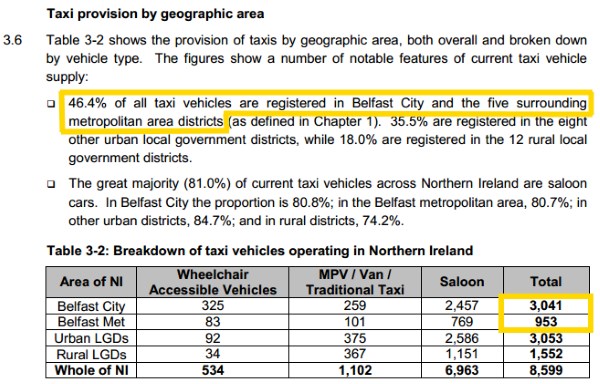
Luckily in the interim, a DOE-commissioned report “Review of Wheelchair Accessible Taxis in N Ireland” has provided an extremely comprehensive overview of the local taxi sector (in beautiful symmetry) between November 2012 and May 2013. The section which breaks down the Northern Ireland taxi fleet makes for interesting reading..
numbers

That’s 6 hacks shy of 4,000 taxis operating in the greater Belfast area according to DOE. And we’re not done yet – this report excludes “taxi buses”, which according to those highly reliable figures in the consultation (219) bumps this total up to over 4,200 taxis operating in the greater Belfast area.

It’s clear that white plate taxis operating inside Belfast must make up the balance. Indeed, this is partially explained in the McCauslands’ letter, where for “registration purposes” white plates are required to be displayed by:

“drivers who may live outside of Belfast but choose to work in the city. In this way there are 20-25 of Value Cabs and 20 fonaCab drivers who work in Belfast but have white-plates as they live outside the city.”

So it turns out that our many sources, cycling campaigners, politicians and the Belfast Telegraph were remarkably on the ball with their estimate of the Belfast taxi fleet. Of course not every taxi will be in those lanes when they’re operational, but then neither will all the other permitted vehicles. What matters is the massive increase in taxis to skew the ratios and outnumber all other users combined – truly we could rename these spaces ‘taxi lanes’.

We campaigned against 4 times the current number of taxis getting into bus lanes – DRD said around 3 times more taxis would be the impact, and now we can be clear that there will be..

at least 8 times as many taxis in Belfast bus lanes

..once this change happens.

This opens up a raft of questions for government:

  • Does DRD still stand over the “3 times” increase assessment?
  • How flawed was the consultation process especially given 86% of people objected?
  • Can the Driver and Vehicle Agency actually provide a 100% accurate assessment of Belfast taxis?
  • What work has been done on the impact on Metro / Rapid Transit of 8 times the number of taxis using bus lanes?

In the meantime, the graphic below remains the most accurate explanation of how allowing all taxis into bus lanes will affect the balance of transport in Belfast (save for some truly epic increases in cycling in the last few years). After crunching the numbers, the numbers are crushing.

This one’s for you Tom..

UPDATE – 4 November 2014

Peter Weir MLA (he being two-time Cycling MLA of the Year in Northern Ireland) pursued the white plate taxi issue with the Minister of the Environment in a written question at the Northern Ireland Assembly:

AQW 37855/11-15
..how many vehicles with … advanced booking only plates currently operate from private hire companies within Belfast city limits.

DOE could have looked at the article above, looked to its own report (quoted above) for an estimate of the size of the ‘phantom fleet’ of white plate taxis operating in Belfast (it’s over 4,000 in case you didn’t already know) but instead the Department which is leading on taxi reform, which wants to revolutionise the taxi sector in Northern Ireland and improve the experience of customers and operators DOES NOT KNOW HOW MANY TAXIS ARE OPERATING IN BELFAST..

Information is not stored on the Taxi Licensing IT system in a way that would facilitate your request for the number of advanced booking only plates currently operating from private hire companies within Belfast city limits.

Neither DOE nor DRD are in any position to properly assess the impact of flooding Belfast’s bus lanes with taxis. This farcical situation rumbles on – the absurd Taxis in Bus Lanes policy lies in tatters, but it is STILL being pushed against all will – except that of private taxi firm owners. Take a bow DOE.
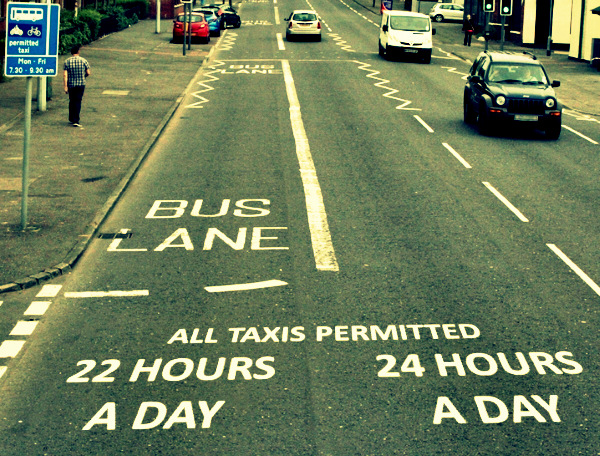
It’s not surprising that an issue like taxis in bus lanes can turn emotive. The toll on perception of cycling safety has been passionately expressed through public comments in a 2013 petition. (Current) ‘private hire’ taxi drivers in the media convey a sense of an important public service being denied a rightful place in bus lanes, describing access as “essential“, “important” or key to “enhancing and improving the taxi industry”.

But what is the actual impact of restricting bus lane access for these taxis? NI Greenways got hold of a bucket of white paint and added some much-needed perspective..

Bus Lanes 22 hours

Is this really so restrictive in the grand scheme of things, only on weekdays? The addition of new Belfast city centre bus lanes with longer operating hours makes muddying the waters easy for the taxi lobby, but this simple idea holds true across most of the city.

But how much of the city has this (dare I say) minor restriction for (current) private hire taxis?

BusLanes

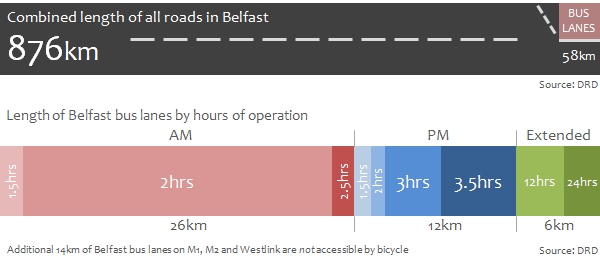
58km of roads with a bus lane seems like a pretty small proportion of the city’s total road network, even if they’re situated on routes with high traffic demand. Amazingly even Belfast’s cycle lane network is longer!

The majority of Belfast’s bus lanes operate for just 120 minutes or less in the morning rush hour. Bus lanes with extended operation account for just 6km, and includes many areas outside of the city centre.

With around 100 bus lanes across Belfast where taxis could be put into competition with cyclists by allowing access, the median bus lane length is just 320 metres. Is this really so crucial to overall taxi journey times in the city?

Demands, but little demand

When the owners of the big taxi firms play up the importance of bus lane access for their businesses and customers (and they will) remember this:

“It is also important to highlight that of the total number of taxis operating in Belfast, the majority do so at evenings and weekends – times when there is little or no use of bus lanes by other road users.” 
William McCausland [fonaCAB] and Stephen McCausland [Value Cabs], correspondence with Regional Development Committee, April 2013

Taxi firm owners can’t have this both ways – if bus lanes aren’t essential to the majority of their operational fleet, then why do they demand access?

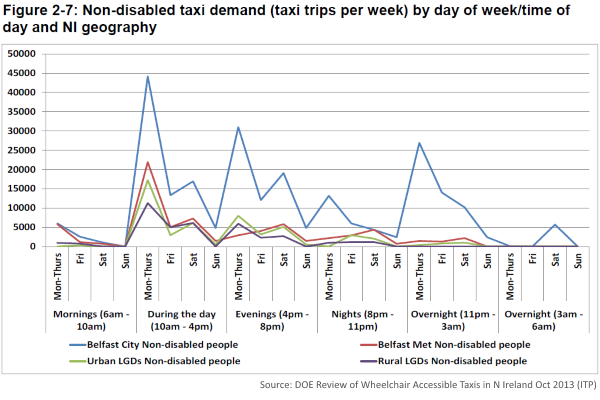
If only there was government-commissioned research to give us an important perspective on the size of their passenger market during bus lane hours..

NonDisabledTaxiDemand

Almost every AM bus lane in Belfast (city and metropolitan area) ceases operation at 9.30am – well ahead of the peak demand for taxi trips in the city. There’s little doubt that peak demand from commuters by bus, motorcycle and bicycle (not to mention private vehicles) is exactly in morning bus lane operating hours. So why is bus lane access so essential for (current) private taxis again?

There’s greater taxi demand in the evening (in the city but not metropolitan area) but the city’s PM rush hour is less congested than the AM version – you only need look at the PM bus lane lengths and hours of operation (in blue, above) to see the difference.

Those little windows of opportunity for enjoy calm and clear bus lanes are greatly valued by people cycling in Belfast, and are crucial to the continued success of the Metro bus system. They’re clearly coveted by private taxi firms and drivers, but it’s important to remember how little of the road system bus lanes take up during short periods, and how little use taxis claim they’ll make of them – backed up by a remarkable lack of demand.

Next: 4,000+ taxis in bus lanes..

In 2013 hundreds of people with an interest in protecting cycling took to the streets of Belfast, signed a petition or engaged their politicians to stop thousands of taxis being allowed into bus lanes. The issue disappeared, but this wasn’t a victory – simply a delay. Decisions in the next few weeks will determine the future of sustainable transport in Northern Ireland.

TBL2_LRG

Department of the Environment (DOE) Minister Mark H Durkan has now announced a timetable to implement Taxi Reform, with single-tier licensing expected to become operational in January 2015. But what does that mean?

Continue reading “Fightback | Taxis in bus lanes”

The Northern Ireland Assembly witnessed an unprecedented rise of the bicycle onto the political agenda in 2013-14. Even the expected boost from the Giro d’Italia couldn’t mask an emergence of everyday cycling issues being promoted by more politicians than ever before. But could anyone unseat the DUP’s Peter Weir as the 2-time reigning, defending Cycling MLA of the Year?

In September 2013 Stormont was hit by a barrage of cycling questions so fierce and unexpected that it was dubbed Cyclegeddon.

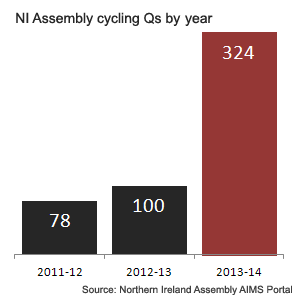
Events moved fast – already an All-party Group on Cycling had been formed; within 5 weeks of the new term more Assembly questions on cycling were asked than in the whole of the previous year; the Transport Minister Danny Kennedy announced the formation of a new Cycling Unit to lead his Cycling Revolution; by the end of the year a remarkable 324 Assembly Questions (Written, Oral, Topical and supplementary) had been asked; and one MLA rose through the ranks to focus minds on everyday cycling issues, almost single-handedly creating Cyclegeddon and in the process landing a knock-out blow to claim the title of..

Cycling MLA of the Year 2014: Daithí McKay (Sinn Féin)

Daithí McKay

Daithí spoke to @nigreenways about his win:

“It’s a great honour to receive this award especially given the fact that this has been the year that the Assembly really did wake up to cycling. I only took up cycling again in August 2013 when I bought a £180 Viking and I was immediately bitten by the bug. After a few weeks I noticed a reduction in stress, an increase in productivity, more energy, less weight and more money in my pocket!

NI_Assembly_cycling_Q_year“What I like most about cycling is that it represents a solution to so many of our problems – an ever worsening state of public health, transport and congestion, mental health and stress, increasing fuel overheads. We have so much potential to realise in terms of cycling and there is a huge demand for it that we can release if we deal with safety and the perception of safety.
“Cycling is now firmly on the political agenda and there is an onus on all elected representatives to ensure that we firstly ‘understand’ cycling and secondly deliver proper infrastructure. A proper cycling strategy with proper funding will deliver better health outcomes and we all need to contribute to a greater public understanding of that fact.”

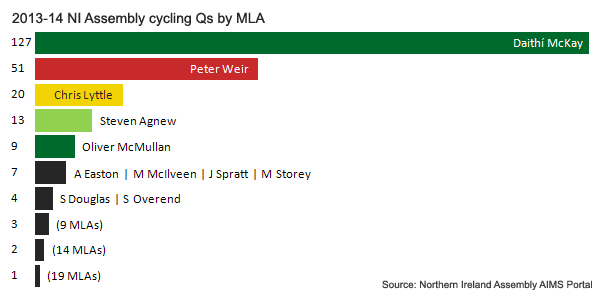
The sustained level of badgering Ministers is worth repeating. Daithí’s total of 127 cycling questions is an average of 3 per week during the Assembly term; it’s more questions than the rest of the top 10 Cycling MLAs of the Year combined. It’s also a 3-figure increase on Peter Weir’s winning totals in the last 2 years (23 and 27).

NI_Assembly_cycling_Q_MLA

That long tail is also impressive – 2 years ago just 28 of our 108 MLAs asked a question about cycling. This year’s total of 53 MLAs means almost half of our political representatives have joined the swelling peloton.

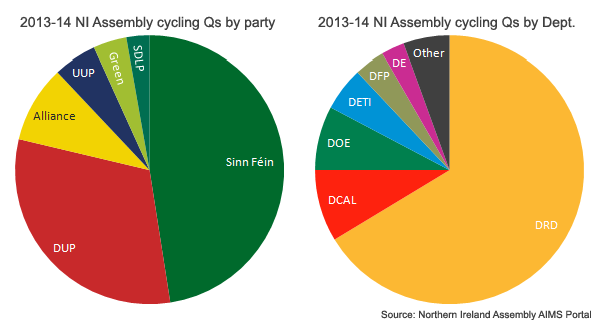
Daithí McKay’s efforts pushed Sinn Féin into top spot among the political parties, rising from the oblivion of just a single question 2 years ago. Steven Agnew continues to ensure the Green Party punches well above its weight, while there were notably no questions about cycling from NI21, TUV, UKIP or Independent MLAs. Read more about NI parties’ cycling policies in Election Cycle.

NI_Assembly_cycling_Q_party

DRD naturally took the brunt of Cyclegeddon as the Department which leads on road infrastructure, but each of the 12 Northern Ireland Government Departments featured in the list, with even the Assembly Commission being pestered about implementing the Cycle to Work Scheme at Stormont.

A little less cycle promotion, a little more action please..

Cycling promotion has arguably been the primary focus in NI over the last decade, save for some fantastic focused government investment in facilities like the Comber Greenway. But with increasing recognition that physical changes will be needed to deliver the cycling revolution, questions on infrastructure nudged into the lead in 2013-14. Pat Ramsey’s 20mph Bill provoked a series of questions and the forthcoming Belfast Bike Hire scheme kept MLAs interested through the year.

NI_Assembly_cycling_Q_topic

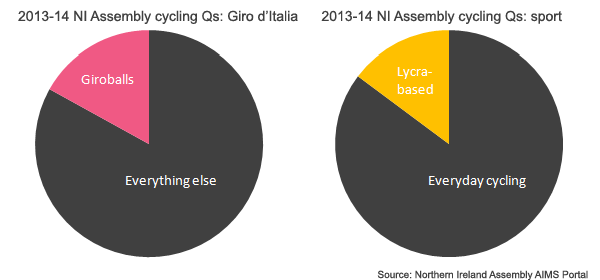
The split between questions on sport cycling and everyday cycling was encouraging, especially in the year when the Giro d’Italia rolled through Northern Ireland – MLAs had plenty of questions to ask on the Giro, from criticism of the route to seeking detailed plans for the legacy.

NI_Assembly_cycling_Q_sport

More than just questions

A full Assembly debate on the Giro d’Italia and legacy in April naturally hovered around future sporting opportunities and tourism benefits, but a series of MLAs brought the focus back to everyday cycling and #space4cycling in their contributions.

“That this Assembly recognises that the Giro d’Italia is one of the biggest events in the international sporting calendar; warmly welcomes it to Northern Ireland; acknowledges the significance and magnitude of being chosen to host the Grande Partenza; understands the benefits to be obtained in terms of the economy, tourism, cultural exchange and education, promotion of a healthy lifestyle, and worldwide publicity for Northern Ireland; and calls on the Executive to take all necessary steps to maximise the potential to be gained through such a prestigious event, and to allocate adequate resources for the delivery of a suitable Giro legacy plan to include improved provision and infrastructure for schools, commuting, leisure, tourist and sporting cycling in Northern Ireland.”
Read the full text of the debate on the NI Assembly website.

The Regional Development Committee even got in on the cycling surge by visiting the Great Western Greenway in Mayo and launching its own Inquiry into the benefits of cycling to the economy.

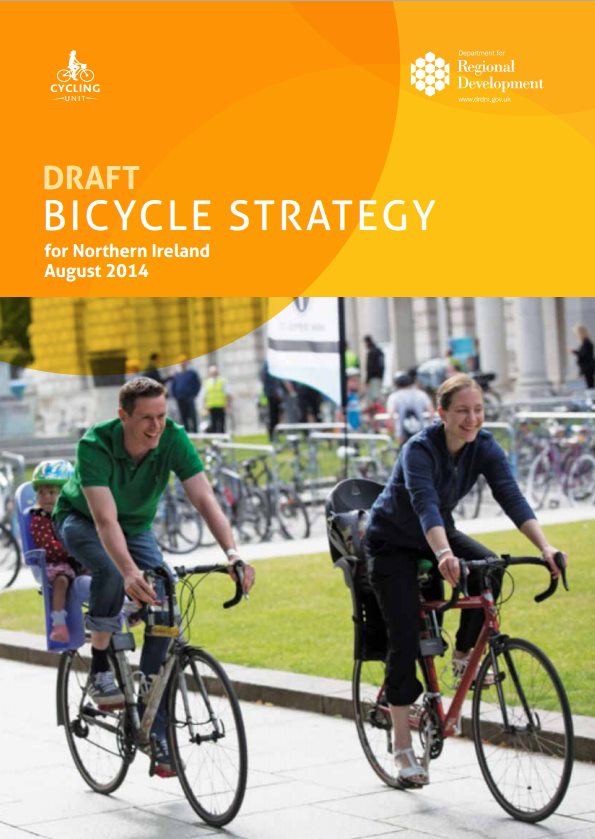
A review of the last year must finish by mentioning the one MLA most responsible for this swirling vortex of cycling issues, the Regional Development Minister Danny Kennedy. From creating the Cycling Unit (which has recently launched a draft Bicycle Strategy for Northern Ireland) to visiting Copenhagen and Malmö on cycling study tours, to hosting cycling events and even taking part on Ride on Belfast – the Minister has continued to take the early steps to fulfil his pledge to create a cycling revolution in Northern Ireland.

– – – – – – – – – – – – – – – – – – – – – – – – – – – – – – – – – – – – – – – – – –

Yes, but what were they all asking?

Over 300 questions were asked, but Ministers’ answers are not usually a font of great insight or shocking revelation – that’s the nature of how the system works. But a few nuggets of interesting information could be unearthed. If you want more detail, you can download the full ‘2013-14 Assembly Questions on Cycling’ dataset (XLSX, 166K).

On the restriction of bicycles on trains before 9.30am..

“On very early trains and on contra-commute trains, i.e. trains operating out of Belfast in the mornings, Translink do already regularly carry passengers with bicycles. This is done at the Conductor’s discretion and Conductors have been briefed to accept cycles where capacity permits, i.e. no expectation of standing passengers in the cycle area. However the majority of trains to Belfast operating before 08:00 are already carrying significant numbers of passengers. For information there are no travel restrictions placed on the number of folding bicycles which may be carried on trains. These may be carried at any time, including prior to the normal 09.30 restriction.”
DRD Minister Danny Kennedy answering AQW 25264/11-15 Daithí McKay (also AQW 26579/11-15 Steven Agnew and AQW 34587/11-15 Daithi McKay)

On cycle-specific lights at junctions..

There are no cycle filter lights currently installed on my Department’s road network. [However..] I am aware the Department for Transport has issued a site-specific authorisation for the use of eye-level cycle traffic lights at Bow Roundabout in London for a trial period. My officials will review the outcome of the trial before making recommendations on their use here.”
DRD Minister Danny Kennedy answering AQW 28890/11-15 and AQW 29558/11-15 Daithí McKay

On missing the point of why 50% of people cycling over Belfast’s Albert Bridge use the footway (objective v subjective safety)..

“The bus lane / cycle facility on the Albertbridge Road, approaching the Albert Bridge, was provided in 1996 to accommodate buses, cyclists and taxis approaching the city centre. The merge arrangement, provided at the end of the bus lane, where the road narrows for the Albert Bridge, is a common layout which operates at other locations in Belfast and elsewhere. Collision records, provided by the PSNI, for this location are monitored, as part of the normal collision data gathering exercise. Over the last five years records show there have been no reported injury collisions at this merge location, involving cyclists.”
DRD Minister Danny Kennedy answering AQW 27035/11-15 Daithí McKay

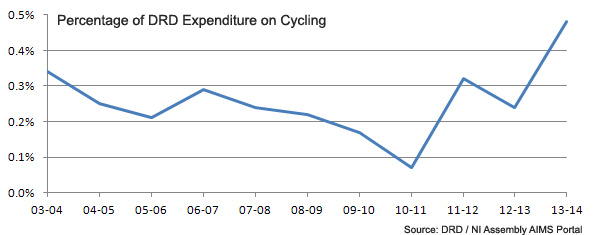
On the budget allocated to cycling over the last 10 years..

NI_Assembly_Cycling_Budget

“The recently established Cycling Unit, will seek to coordinate and promote the work being taken forward in relation to cycling and as such, spend on this activity is expected to increase in future years.”
DRD Minister Danny Kennedy answering AQW 26785/11-15 Steven Agnew

On the world famous #BinLane..

“Traffic Attendants patrol Upper Arthur Street several times each day and during the twelve month period to 30 September 2013, six Penalty Charge Notices (PCNs) were issued for contraventions in the cycle lane. However, I understand a further 631 vehicles were recorded but drove away before a PCN could be issued. It is also not clear whether these offences can be attributed to parking in the cycle lane as this information is not recorded.
With regard to bins blocking cycle lanes, this has been reported to Roads Service on a number of occasions. Where a bin has been presented for collection and has obstructed the cycle lane, any complaint will be investigated to establish ownership. My officials have, in the past, spoken to the relevant owners and advised them of their responsibility to ensure that the bin is not placed in the cycle lane, and that once it have been emptied by the collection service, it should be removed from the street immediately after. Where ownership has not been established or where owners have failed to cooperate with my officials, these bins have, with the assistance of Belfast City Council, been removed.”
DRD Minister Danny Kennedy answering AQW 26728/11-15 Daithí McKay

On cycling levels in deprived areas [good idea for a blog post that]..

“[By awesomely mashing up the NI Travel Survey with Deprivation Measures..] It was found that respondents living in the 20% most deprived areas were less likely to have cycled in the last 12 months than the NI population as a whole. Conversely, respondents living in the 20% least deprived areas were more likely to have cycled in the last 12 months compared to the overall NI population. Looking at the respondents living in the remaining areas, there was no real difference in the proportion of those who had cycled in the last 12 months compared to the NI total.
It must be remembered that levels of cycling in specific areas cannot simply be attributed to the level of deprivation, for example the geography of a location can be a contributory factor as to whether people cycle or not. Levels of cycling may also be impacted where low cost, widely available modes of transport such as black taxi ‘bus’ routes are available.”
DRD Minister Danny Kennedy answering AQW 34855/11-15 Daithí McKay

On the total length of cycle lanes in Northern Ireland..

My Department has currently provided approximately 235 miles of cycle lanes across Northern Ireland.
DRD Minister Danny Kennedy answering AQW 30598/11-15 Alex Easton

On cutting a Belfast city centre residential rat run to motor vehicles..

The closure of Barrack Street, Belfast to through traffic derived from the ‘Belfast On The Move’ strategic review of traffic within Belfast City Centre. Roads Service had previously been aware of local residents’ concerns over the volume and nature of through traffic in this street and took the opportunity to address those concerns within the overall scheme proposal.
Whilst there has been no formal assessment carried out on the specific benefits of the closure of Barrack Street, it is considered the stopping-up has returned the area to being a residential street for the benefit of all those who live there.”
DRD Minister Danny Kennedy answering AQW 29509/11-15 Daithí McKay

On recognising the value of investing in cycling/walking at tourism hubs..

“[DRD has] a very extensive scheme proposal that will provide a footpath/cycle path extending for approximately 3.5km from Bushmills to The Aird. However, given the potentially high costs involved, any scheme delivery will need to be carried out in stages.
My officials are currently developing the stage proposal from The Aird to The Causeway, which is significant stretching for approximately 1.5km. The scheme will require the acquisition of a large tract of land. My officials have already met with one of the principal landowners, The National Trust, and will be arranging to meet with other landowners over the coming months.
Subject to the availability of funding and successful acquisition of the necessary land, I am hopeful this scheme will be able to be considered for inclusion in a works programme in the near future.”
DRD Minister Danny Kennedy answering AQW 34316/11-15 Robin Swann

All Assembly questions data sourced from the excellent Northern Ireland Assembly AIMS Portal. See the Open Northern Ireland Assembly Licence.

There is cause for optimism and much to applaud in the Department for Regional Development (DRD) strategy document for cycling in Northern Ireland. Here are some highlights, slightly trimmed for space:

“..to provide greater choice in the way people travel [we] will work .. to reduce the need for longer journeys and to increase the opportunity for travel by bicycle. This will entail the development of high quality local cycle facilities within new developments and the provision of links with other urban cycle networks, public transport interchanges, the National Cycle Network and the countryside.”

The “..strategy identifies a range of measures that will seek to improve conditions for cyclists and establish a pro-cycling culture. If more people are to be encouraged to cycle, a fundamental shift in attitude will be needed in every part of our society. An increase in safe utility, recreational, tourist and competitive cycling can have economic, health and environmental benefits for society as a whole.”

“Concerns about road safety and our climate are often quoted as reasons why few people cycle in Northern Ireland. However, significant increases in cycling have been achieved through pro-active policies and actions in other European countries having similar weather conditions.”

The “..creation of a cycle-friendly road network is important if more people are to be encouraged to cycle. The traffic management measures needed to improve conditions for cyclists .. will involve the re-allocation of road space from the motorist to the cyclist, however, this will require a fundamental shift in attitude on the part of transport and infrastructure providers and the support of the general public.”

“Our long-term infrastructure objective is to create a network of high quality cycle routes .. [these] may be on-road or off-road and will include dedicated cycle tracks, shared use surfaces, traffic calmed roads and may make use of paths across parks and other open spaces.”

The “..conversion of footways and footpaths to shared use by cyclists and pedestrians will only be considered where there is no other opportunity to improve conditions safely for cyclists on the carriageway or elsewhere.”

We will “..implement an ongoing programme of secure, convenient and, where appropriate, covered cycle parking provision at new and existing main public transport interchanges and park and ride sites .. [and] in main town centres.”

We will:

  • develop local cycling targets and strategies that will encourage more people to cycle
  • implement a programme of traffic calming schemes and 20 mph zones and afford greater priority to collisions involving cyclists in the prioritisation of these schemes;
  • monitor road traffic collisions in which cyclists are involved and initiate appropriate remedial action
  • improve cycle access in towns by the development of planned urban cycle networks and provide at least an additional 50 miles of urban cycle route
  • adopt recognised good practice in cycle-friendly provision and apply detailed cycle audit procedures to ensure that pro-cycle facilities are actively considered during the design of road schemes
  • apply cycle review procedures to major commuter corridors in Belfast and Londonderry

“In developing an action plan to address these issues, the objective will be to achieve a shift in the perception and behaviour of a large section of the general public.”

Targets:

  • double the number of trips by cycle in 5 years
  • quadruple the number of trips by cycle in 15 years

The “..strategy represents a significant commitment to cycling by Government.”

The strategy contains some excellent and progressive content, setting a strong commitment to embedding cycling firmly within the transport mix in Northern Ireland. There’s even recognition that “dedicated cycling tracks” are needed in urban areas which will take road space away from motor vehicles. It talks the talks, and promises to walk the walk – just what a progressive cycling strategy needs to be in 2014.

Except (if you haven’t it figured out by now) this isn’t from the new draft Bicycle Strategy for Northern Ireland 2014.

BicycleStrategyNI

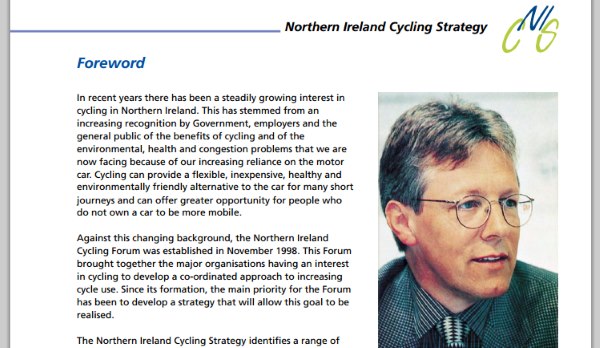
This is all lifted from the Northern Ireland Cycling Strategy 2000 (PDF, 8.56MB) published back when the politician at the DRD helm was the future First Minister of Northern Ireland, Peter Robinson (to this day a regular cyclist). Technically, it’s still the framework for cycling in Northern Ireland (that second target was to 2015).

PeterRobinsonCycling

This isn’t a full autopsy on the 2000 strategy to determine its failures and successes; for the most part, that will be obvious with even a basic knowledge of current cycling conditions here. In reading DRD’s new strategy, it’s important to remember our history, so that we are not doomed to repeat the mistakes.

I’m not even going to critique the new draft Bicycle Strategy for Northern Ireland line by line – smart heads in DRD have kept it light and punchy, easy to read – so go and draw your own conclusions (PDF, 699K). It’s in consultation until Friday 21st November, so if you have even a passing interest in seeing cycling conditions improve in Northern Ireland please send your views to cycling.unit@drdni.gov.uk. I’ll publish my submission when it’s sent.

Cargobike Dad tackles the new strategy and matches my own positive thoughts on how its shaping up. However, this includes the concerning use of cyclist ‘user profiles’ to influence future route design. Dutch cycle network design principles and density means everyone can cycle everywhere. DRD want to be “visionary in our approach and we want to embrace innovation” so why this rush to compromise at the outset? Hopefully concerns will be taken on board.

https://twitter.com/seanlondonandon/status/504670674862866432

.

In the encounters I’ve had with DRD staff who wrote the strategy (the new Cycling Policy Unit) I’ve found them to be genuine, passionate, open, honest, pragmatic but genuinely open to ideas, savvy operators in a tough Departmental environment and (should it matter) all normal everyday cyclists – the right people in the right place at (hopefully) the right time. They deserve a chance to make a difference.

.

What I’m looking for in the new Bicycle Strategy are signs that DRD thinking has moved on from the previous strategy:

  • that best practice in infrastructure design and network density from established cycling countries will factor in plans and, crucially (given past experience) that cycling plans won’t be vetoed within DRD / Transport NI by more influential voices
  • that DRD recognises and wants to grasp the unique opportunity and tools of centralised government executive powers to set Northern Ireland on a course to surpass other areas of the UK and Ireland, not coast in the wake of their failure (in comparison to Netherlands / Denmark etc)

Despite the hyperbole of Danny Kennedy’s call for a “cycling revolution”, I am sold on the Minister’s commitment (and that of his advisors and staff) to what cycling investment can deliver for his department and for Northern Ireland.

Yet two things might override these good intentions:

  • elections in May 2016 which will almost certainly see a new Minister in place (likely from a different political party) who may not share the developing vision for cycling
  • an over-reliance on ‘gambling’ for monitoring round money to deliver cycling projects, rather than a fixed proportion of central funding

Austerity is beginning to rain down hard on budget rounds, and only half of DRD’s £2m capital bids for cycling in June were approved. What chance will cycling have during future budget squeezes, without reliable core ring-fenced funding?

One sentence from the new strategy shows why this is fundamental to success, and why the old strategy didn’t achieve much:

Since 2002 the Department has invested over £10 million in the development and expansion of cycle lanes and on cycling infrastructure measures.

Which broadly speaking means DRD committed around 50p per head of Northern Ireland population each year for most of the lifetime of the 2000 strategy, compared to €24 in the Netherlands. And the headline result*?

NI bicycle journey share in 2000? 1%.

NI bicycle journey share in 2013? 1%.

In hindsight it’s fortunate that the 2000 strategy tried to “encourage cyclists to wear helmets” because that’s 14 years of head-butting brick walls. However there are some encouraging recent signs of cycling growth in Belfast especially, and DRD’s future plan to raise annual per head spending to £4 may begin to make some impact.

It’s important to set the new Bicycle Strategy for Northern Ireland in this context – it’s a positive high-level vision, but words don’t guarantee significant change, as the 2000 document shows. The devil will be in the detail of delivery plans, local masterplans, securing continuous funding and retaining political will. Hopefully this time round things are different, and I wish DRD well at the start of their new journey.

*DRD NI Travel Survey: Average number of journeys per person per year

Northern Ireland’s much heralded Cycling Revolution™ is going to need some great promotion to become a reality. Step forward our Department of the Environment (DOE), where local road safety promotion sits in isolation from the road builders (and revolutionary vanguard) over at the Department for Regional Development (DRD).

Recently DOE launched their first ever cycling safety video Respect everyone’s journey. It was a reasonable first effort, notwithstanding plenty of valid criticism. At least they wisely stayed away from the schlock-horror of their usual road safety adverts (see the international viral “hit” Shame on You).

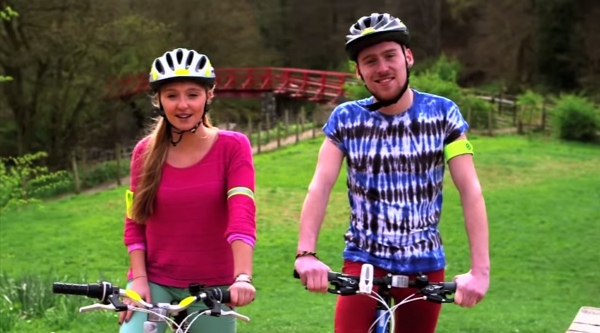
ChrisErin

A follow-up cycling video has been uploaded to YouTube, which shows how far DOE has slipped in just 3 months, and manages to perfectly capture how poor the cycling conditions and expectations are in Northern Ireland:

[youtube https://www.youtube.com/watch?v=sJ40bHE1OPA?rel=0&w=600&h=450]

.
Comments on YouTube are (wisely) switched off, but the video has already attracted scorn and ridicule on social media.

https://twitter.com/AngelaJWallace/status/490026202498072577

Here’s 10 of the top reasons why it’s so bad, in no particular order:

#1 That target audience?

It’s difficult to see who the video is trying to patronise reach. But on closer inspection..

“Cycling’s a great way to get around .. but that doesn’t mean you can forget about hazards, or who you share the space with .. we all have to respect everyone’s journey, whether you’re on the road, or in a cycle lane”

So it’s those death-wish cyclists with no regard for the rules of the road, who put themselves and others in danger, and generally don’t give a damn about respect – they’re the target audience. I reckon DOE’s instinct that a twee instructional video will make them think again is spot on.

#2 Image quality

As with DOE’s previous video, I’m already struggling to see cycling as normal because of the awful music. Simple Minds behind the scenes – indeed. And Chris and Erin seem dressed and ready to appear in a James Bond opening title sequence rather than going for a cycle, because NO-ONE DRESSES FOR CYCLING LIKE THAT. EVER.

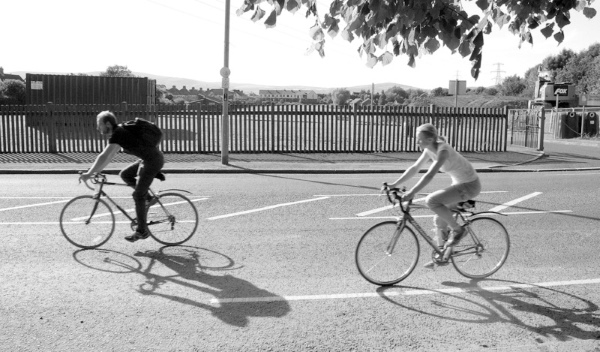
Hiya DOE, here’s a modern image of cycling in Belfast, ironically taken the same day your video was published:

GrandParade

#3 Cycle tracks

Using the Stranmillis Embankment is an interesting choice. It’s by far and away the best on-road cycling space in Belfast, and was only just beaten into 2nd place by Derry’s Peace Bridge as NI’s best cycling infrastructure in the 2013 Fréd Awards.

It’s also wholly unrepresentative of the typical cycling experience here. In fact, there are just 3 separate cycle tracks in Belfast, totally just 2.5km in length. Making a video to explain how to use a cycle track (and generally how to interact with other humans) is overkill.

The Giro d’Italia passed along here in May 2014, but just weeks before the event, DRD’s Roads Service introduced another user to compete with cyclists – a variable message sign (and they got mildly arsey when people complained). Share the road indeed!

.

#4 “A good tip is to try and avoid the busiest times on your route; it’ll make your journey quicker, and smoother.”

According to DOE, cycling is not something you should be doing during rush hour; grow up and get a car for that, kids. It’s not like anyone would want to cycle to work, or to the shops in the morning, or hop on the bike for a 9am appointment etc.

If you’re daft enough to try it, expect a slow, rough journey. Hmm. Now you mention it, that’s a scarily accurate representation of cycling in Belfast’s rush hour. Finally some feckin’ honesty and insight – chapeau!

#5 Promoting shambolic infrastructure

At 3.42 and 4.35 I became convinced that the video was a scalpel-sharp piece of satire – you got me DOE! It’s one thing that the Ormeau Road Bus Shelter and University contra-flow lane were voted in the top 5 worst pieces of infrastructure in the 2013 Fréd Awards (beaten only by a dinosaur tail – true story), but quite another for the government to then think it appropriate to use them in a cycling promotion video.

Plonking a bus shelter in the middle of a shared use path is a nightmare for everyone using the space, more so for families with children or elderly people walking around the back. Don’t tell us how to navigate crap design, tell DRD how to redesign it!

https://twitter.com/ibikebelfast/status/490029456200040448

This is also NI’s first attempt on video to promote the contra-flow cycle lane concept, or at least DRD’s awfully executed attempt. If you need to use the phrases “But the danger is..” and “This is where you really need to be on high alert..” you’re admitting it’s dangerous crap, so just get rid of it!

https://twitter.com/AngelaJWallace/status/490024940624949248

.

#6 Those reflectors

While being thoroughly patronised by this video, I knew I’d have to admit that DOE had all their facts sewn up, that their advice was legally watertight and all information presented would be factually correct. Every scene shows someone cycling in daylight hours, not between sunset and sunrise. So it’s safe to assume when Erin says ‘by law, you must have a red rear reflector and amber pedal reflectors” that means not just when the sun’s gone down, right?

#7 “Bus lanes are there .. to make your journey smoother and faster, but because they’re shared with buses, permitted taxis and motorbikes, they can be extremely busy”

Damn right bus lanes are busy – by January 2015 DOE will create a single tier taxi system which will force the number of taxis in Belfast bus lanes up from 500 to around 4,000. Good idea to gloss over the destruction of cycling subjective safety at rush hour (hiya point #4).

.

#8 “Before you make any move .. always look around you, especially behind, and give a signal if necessary”

NoSignal

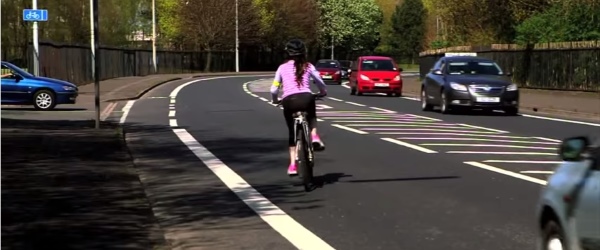
..says Erin at 4.20. Meanwhile, back in the mists of time at 4.10, the girl in the video makes a ridiculous move without signalling her intent to the Renault Clio. All happy smiles and waves in the video; try that in the real world, and there’s more chance she’d end up in A+E.

https://twitter.com/ellenfromnowon/status/490102359243378688

https://twitter.com/richardholywood/status/490042413487239168

.

#9 “By the way, footpaths (as the name suggests) are for feet”

Can you say ‘Equality Impact Assessment’? Wheelchair users and those on mobility scooters might have a few things to say about your interpretation here, DOE. While riding on many footways is illegal (footway or footpath – check those legals again) and generally frowned upon (never mind slower, bumpier and probably more dangerous) it’s a symptom of poor infrastructure – people are scared away from traffic, and want to cycle in what seems like a safer place. Build better routes and more protected cycling space, then people will simply choose the better alternative.

#10 “Respect other road users, because we all share the same space”

This is exactly the problem. The whole video is one long excuse for bad infrastructure, glossing over decades of under-investment in cycling. Countries with the highest cycling levels separate cycling as a transport mode distinct from motor vehicles and pedestrians, or unravels (high quality) cycling routes from the the busiest roads altogether.

DOE admits (whether knowingly or not) that trying to ride a bike around Belfast is made difficult and dangerous because cycling is not properly catered for, because we have to compete with cars, lorries, buses, taxis – and then offers up some random methods for coping, to varying degrees of usefulness.

* * * * *

Really, this only scratches the surface of the things which are obviously wrong with this video, and the swathes of underlying assumptions and daft language which other ‘road users’ are not subject to, like:

It’s a truly ill-advised piece of nonsense which does nothing to advance cycling promotion in Northern Ireland. Perhaps it’s time for DOE to fully hand over the reigns on this function to DRD’s Cycling Unit, who (from personal experience) actually know a thing or two about urban cycling.

https://www.facebook.com/BelfastBikefast/posts/317025061809199

https://twitter.com/vee_thirteen/status/490023337364443136

https://twitter.com/niroads/status/490233011670364160

https://twitter.com/BruteonaUte/status/490023126638817280


ROBblog


,


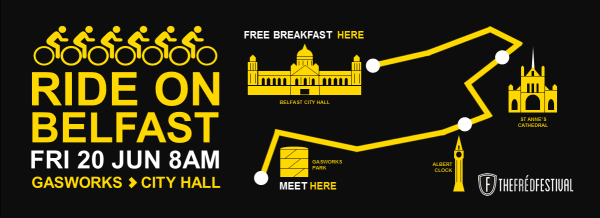
On Friday 20th June 2014, the second annual Ride On Belfast event took to the city streets. Last year, around 70 people rode from the Gasworks to the City Hall, inspired by and assembled under the banner of The Fréd Festival. This year the theme was ruthless expansion, with the twin aims of:

  • being the biggest peloton in Belfast since the Giro d’Italia
  • encouraging people not used to cycle commuting to try it out

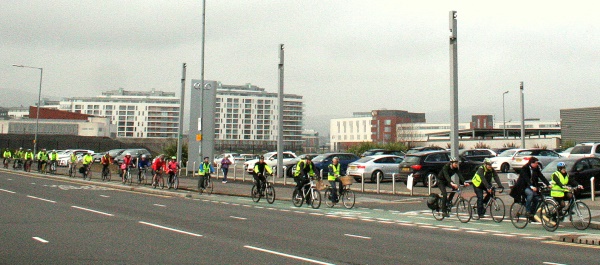
That was the simplest expression of what Ride On Belfast is about – people riding bicycles in Belfast for their own reasons, whether being the most practical way to work, for the school run, for their health or just the enjoyment. It’s not a protest, it’s not ‘taking back’ the roads, it’s not causing aggro to others – just riding a bike.

But to make this year really special, we needed some new, innovative tactics..

The Weather Underground

Belfast is used to long arid summers, heatwaves lasting months and emergency air-drops of Mr Frostie supplies, but Fréd and his goons needed to be sure that precipitation wasn’t going to affect Ride On Belfast. There was nothing for it – with a brass neck, we tweet-bombed all of the finest weather presenters on local television, and Frank Mitchell too.

And by jove, the BBC crew got into the spirit, with Angie Phillips retweeting, Barra Best tweeting his own predictions, and the fabulous Cecilia Daly (the new darling of Belfast cycling) going the extra mile..

And so, the day before Ride On Belfast gathered, we got our first official ‘national’ weather forecast!

[gigya src=”https://abfiles.s3.amazonaws.com/swf/default_player_10.swf” style=”background-color:transparent; display:block; box-shadow:0 0 1px 1px rgba(0, 0, 0, 0.15); min-width:349px; max-width:700px;” flashvars=”image_option=small&imgURL=https%3A%2F%2Fd15mj6e6qmt1na.cloudfront.net%2Fi%2F9638374%2F300x300%2Fc&link_color=%23c70067&mp3Author=nigreenways&mp3Duration=45505.0&mp3LinkURL=https%3A%2F%2Faudioboo.fm%2Fboos%2F2273070-ride-on-belfast-gets-a-personalised-weather-forecast&mp3Time=11.43pm+21+Jun+2014&mp3Title=Ride+On+Belfast+gets+a+personalised+weather+forecast&mp3URL=https%3A%2F%2Faudioboo.fm%2Fboos%2F2273070-ride-on-belfast-gets-a-personalised-weather-forecast.mp3%3Fsource%3Dwordpress&player_theme=dark&rootID=boo_player_1&show_title=true&waveimgURL=https%3A%2F%2Fd15mj6e6qmt1na.cloudfront.net%2Fi%2Fw%2F724171″ width=”600″ height=”150″ allowFullScreen=”true” wmode=”transparent”]

And as it turned out, the weather was just about perfect on the day..


The Gathering

https://twitter.com/ellenfromnowon/status/479874513573019648

This year’s Ride On Belfast was helped by some last minute news from Translink, as their early morning ban on bicycles on trains was eased to accommodate those travelling for the event:

This was a most welcome nod to active travel, and hopefully will give Translink and DRD pause to consider trialling this over a longer period.

https://twitter.com/BelfastCyclist/status/480028818204536833

https://twitter.com/bernie_stocks/status/479921650725814272

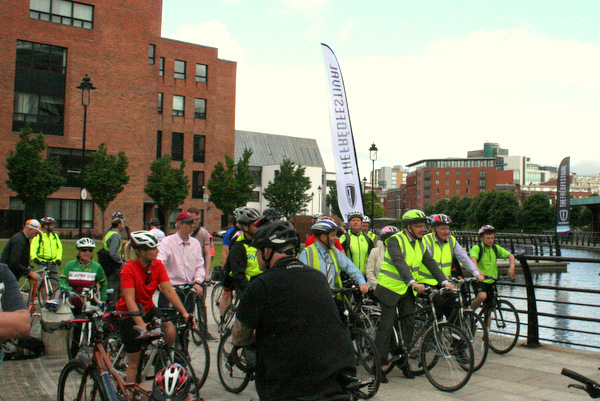
The gathering crowd was impressed to see Northern Ireland’s Transport Minister Danny Kennedy ride into the bunch with his new Cycling Unit in tow. Regular cyclist and MLA Sammy Douglas also joined in.

Minister Danny Kennedy arrives with his bicycle outrides
Minister Danny Kennedy arrives with his bicycle outriders


The Grand Départ

Under severe pressure from hungry commuters, the peloton set off a little earlier than planned. With a tight first turn from the Gasworks green onto the road, the Minister seized his opportunity and put in a devastating early kick. This split the peloton at the Ormeau Road crossing, and the breakaway group was never caught again. Apparently, Danny Kennedy’s sprint finish down Donegall Place was a phenomenal sight.

https://twitter.com/MrVirtualGill/status/479892607603343360

[youtube https://www.youtube.com/watch?v=XbGdaI6zEqc?rel=0&w=600&h=338]


On The Open Road

This year Ride On Belfast took an extended trip around Belfast, leading to an iconic roll down Royal Avenue towards the City Hall. The PSNI officers took a relaxed back seat this year, yet the busier junctions were taken with ease. Notable pinch points (again) were the length of time to traverse Shaftesbury Square (not great for cycling at all) and the bus lane at Great Victoria Street (still not great for buses, never mind cycling). Holding the outside lane along Carrick Hill worked to control what was expected to be the busiest and fastest traffic of the ride. The traffic-restricted streets of the city centre were a joy.

[youtube https://www.youtube.com/watch?v=5uxRPmcbSYY?rel=0&w=600&h=338]

https://twitter.com/GeoffCaves/status/479919201080311808

https://twitter.com/jonathan_alban/status/479886080544882688


Selfie On Belfast

After the last year with Máirtín Ó Muilleoir as Lord Mayor, Belfast has fallen in love with the selfie. As well as people just taking them for the craic, See.Sense also ran a competition for the best selfie taken by their stand at Belfast City Hall..

https://twitter.com/BelfastAikido/status/479895033630699520

https://twitter.com/KillinchyCC/status/479929158337069056

https://twitter.com/GeoffCaves/status/479915437950763008

https://twitter.com/dbinterz/status/479921452708548608

https://twitter.com/clairemulv/status/480005258463416320


City Hall and well-earned grub

A huge thank you again to Travelwise and Belfast City Council for providing a free breakfast at the Bobbin Cafe (and the new option of a free coffee at Javaman) for those who completed Ride On Belfast. The City Hall grounds became a sea of bicycles for the morning, while local cycle lighting tech firm See.Sense showed off their wares and PSNI bike officers were busy security-marking bicycles for the punters.

Inside the City Hall, the breakfast queue stretched out the door (which is testament to the rise in participation at Ride On Belfast) and we’re all grateful to the Bobbin staff for coping under severe pressure.

https://twitter.com/KillinchyCC/status/479930501453848576

https://twitter.com/lobsterbane/status/479917543784996864


The Media

Straight after the event, our Twitter traffic was enough to set #RideOnBelfast trending locally – maybe next year “sectarianism” can be beaten by cycling? Little steps..

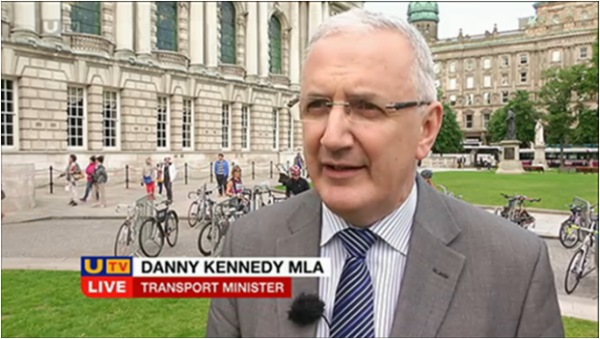
Paul Reilly brought the UTV cameras down to see what all the fuss was about, and importantly set the day in context with a reminder of the shocking scene of a child’s bicycle under a truck at Ballyhackamore the day before. Along with the tragic death of 5 year old Conor O’Neill 9 days before, Bike Week had a strong focus on road safety and infrastructure improvement this year.

DKROB

https://twitter.com/GregorClaus/status/480273772008988672

The Irish News covered the event in its Saturday edition. Might need to check that ear-to-shorthand connection though, as ‘enthusiast’ (a word I’m almost violently resistant to when it comes to practical cycling) somehow crept into a quote. And “giro d’italia” needs capitals. #facepalm


The Aftermath

Ride On Belfast turned out to be a really positive, fun event and this was reflected in social media comments directly afterwards. We had new cycling commuters, people trying out cycling for the first time in years, as well as familiar faces.

https://twitter.com/BarryParke/status/479964204578136065

https://twitter.com/donnakmonteith/status/479984227816337409

https://twitter.com/theflyingfanny/status/479913575453315072

https://twitter.com/lobsterbane/status/479914027989344256

https://twitter.com/donnakmonteith/status/480053273609904128

https://twitter.com/lobsterbane/status/479922578476523521

https://twitter.com/ellenfromnowon/status/479913587113492480

https://twitter.com/ukprototype/status/479951509275566080

https://twitter.com/KillinchyCC/status/479952404700725248

In the end, the various breakaway groups which started from the Gasworks numbered 150, with close to 200 registered for the bicycle breakfast at City Hall. Overall that was a doubling of participation from 2013, which is a credit to all involved – The Fréd Festival, Travelwise (DRD) and Belfast City Council.

Perhaps the Belfast Harbour Commissioners don’t yet realise the significance of what they’ve created on Sydenham Road.

In a sense their separate cycle path (arguably the best stretch in the city) is an interesting symbol of the changing nature of Belfast’s Harbour Estate. The area is moving further away from the days of heavy industry to a clever future mix of innovation, education, high skilled jobs with big inward investors, start-up hubs, urban sport parks, education campuses, signature tourism and leisure facilities. With a new resident population growing in hi-spec apartment space, and commuter traffic growing, the area needs a smart, modern transport mix to thrive.

SydSTB
Peloton travelling along Sydenham Road to the opening of the Sam Thompson Bridge

The path was constructed in spring 2013, part of better defined road space. Two extremely wide lanes were split into 4 with the additional space used to create a wide 2-way cycle path, fully kerb separated. Although general traffic capacity was technically doubled, this was still a remarkable example of taking road space away from motor vehicles for cycling – on private land as well.

Who better to get on with the relatively insignificant job of road space reallocation than the Belfast Harbour Commissioners. This organisation, and their forebears, moved heaven and (literally) earth to create and shape a great port city from the sandy shallows of a lough which used to be named after Carrickfergus, the former primary settlement.

Belfast Harbour sits at the junction of 4 great cycling routes – the Lagan Towpath, Loughshore Path, Comber Greenway and Connswater Greenway. With the new Sam Thompson Bridge sited within the Harbour Estate and the ongoing positive reception for the Connswater project, Belfast Harbour is now a key link in Belfast’s active travel chain.

Some clever touches at the points of greatest potential conflict on the Sydenham road cycle path (such as the car showroom access) show there has been real thought about safety and comfort of all road users:

Yet, the Sydenham Road cycle path is in danger of being the Harbour’s high-water mark, as current expansion work and outstanding issues mean the quality of the route is beginning to recede. So what are the problems and potential solutions to the Sydenham Road route?

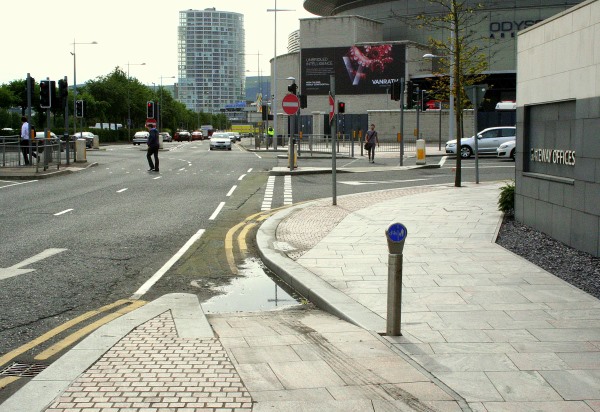
New shared pavement at Dee Street roundabout

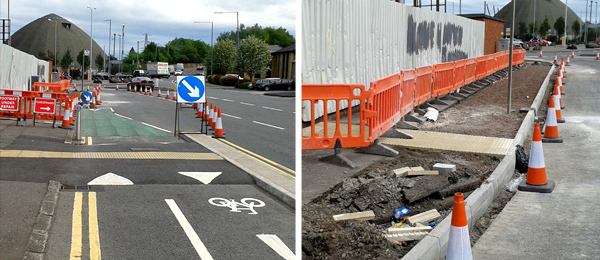
Rumours of works to the Sydenham Road route drew me down to the area in May, and it was disappointing to see a shared footpath solution being constructed at the Dee Street roundabout. From excellent separate #space4cycling to an awful compromise within metres. This is the classic approach to cycle design in Belfast; a cycle lane (and a magnificent one in this case) built where space is easy to take from general traffic, but at major junctions cycling space must disappear to meet the needs of motor vehicles.

Sydenham Road transition from cycle path to shared footway
From high quality separate cycle path to shared footway (with bus stop pole at transition)

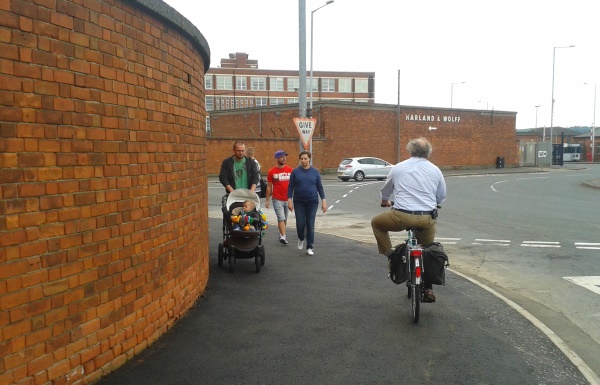
More worrying is the lack of thought about the curve to access the new crossing to Airport Road. After passing a prominent electricity box, a high brick wall obscures the view on a turn which greater than 90 degrees. Faster bicycle traffic will mix with pedestrians here, and the potential for collisions at peak times is now very high.

Wall
A surprisingly busy (now shared-use) blind corner with a difficult mix of users

As nice as the brick wall is, Belfast Harbour could remove it to create more space for dedicated separated cycling and walking space on this roundabout. (Update 26 Jun 14 – reliably informed this wall belongs to a tenant company, so “..Belfast Harbour could approach them to remove it..”) Alternatively, a three-lane roundabout can afford to have enough space clipped off to provide a more continuous cycle route – plenty of examples of best practice exist in the Netherlands.

Smarter investment in altering the roundabout design would also go some way to solving the maddening problem of citybound access to the cycle path from Dee Street and the Sydenham Bypass. If you’re confident enough to have crossed a double roundabout (with very heavy traffic) you have to get from one side of a fast and noisy 4 lane carriageway to the other. It’s utterly impractical and quite dangerous (even when dismounting and trying to walk) for families or inexperience cyclists.

Sydenham
No controlled crossing at the start of the cycle path – a 4 lane nightmare to traverse

Belfast Harbour had a great chance to make a vast improvement on the Odyssey to Victoria Park route; instead the Dee Street roundabout area remains its weakest link.

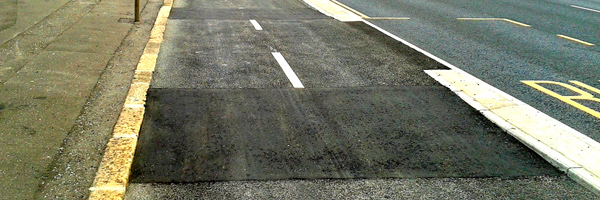
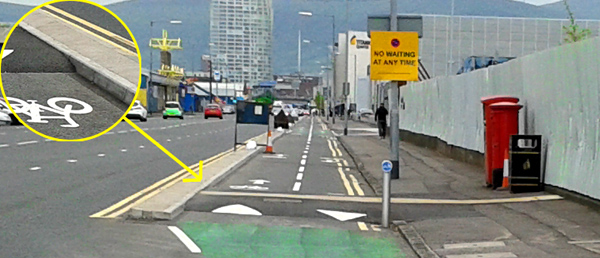
Ramps

A big favourite with patrons of the Belfast Cycling Study Tour, the ramps on the cycle path made little sense, especially given the harsh angles which lead many people to use the road instead. Even at low speed, these provide a hefty jolt to bicycle and rider.

Ramps
Badly engineered ramps mean bicycles and riders take a thumping

Many people wondered why these traffic calming speed humps were missing from the main road.. 😉

Following complaints, Belfast Harbour (to their credit) have altered the approaches on the ‘bus stop ramp’ to allow a smooth transit.

Sydenham Road ramp after works
Belfast Harbour have now eased the angles on one ramp

Yet, strangely, the final ramp near the Dee Street roundabout remains in its original spoke-snapping shape. Unlike the central ramp, which serves a pedestrian crossing to Titanic Quarter train station, the purpose here seems only to access to a bin and post box. The balance of inconveniences seem badly skewed against dozens of everyday users.

Sydenham Road ramp for post box and bin
Remaining ramp with poor angles, serving just a post box and bin

This final problem ramp needs to either be removed completely or the approaches flattened as above.

Route inconsistency

While the main separate cycle path is (bar a few minor bumps) a joy, the Odyssey to Victoria Park route is neither consistent nor continuous – the mark of great cycling infrastructure around the world. If you have to think too much about where you can or can’t be; if signage isn’t clear; if you have to take difficult and seemingly unnecessary diversions; if you inconvenience people, you are not encouraging the use of bicycles.

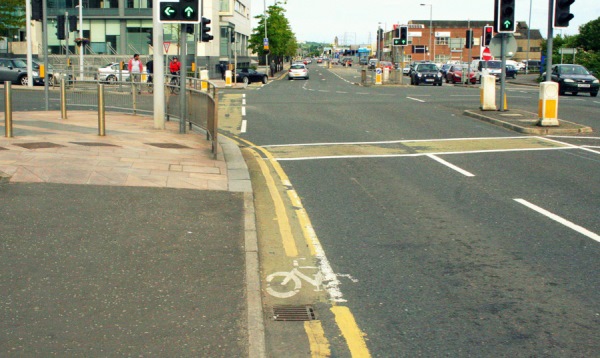
From the Odyssey, you either start on the footway or on the road – there is no dedicated cycling space. At the Queens Road junction you’ll meet this generously wide cycle lane.

Sydenham Road yellow line cycle lane
Possibly the worst cycle lane in Belfast, just metres from the best

Held for an eternity at the traffic lights (sustainable transport journeys really need to have some advantage over motor traffic) you move across an advisory cycle lane and up a ramp onto a shared footway. Not too bad, except coming back the other way the visual queue is to cycle against the traffic – lethal if not illegal?

PermaPuddle2
Ramp invites you to cycle onto the road against the traffic

At the next junction is a similar ramp, with more confusion – cycling down the ramp onto the road doesn’t seem to be affected by the adjacent signal-controlled junction. While many would feel it’s prudent to wait, there’s nothing to caution users that cycling down into the junction is potentially dangerous – leaving a real threat of collision. Where would the responsibility lie?

Ramp1
Do you stop at a red light? Who has priority if you proceed?

The right hand side of the picture above says it all. If you’ve designed a dedicated route for cycling, and you feel that the road beside still needs an advanced stop line for bicycles, your design has failed.

Drainage

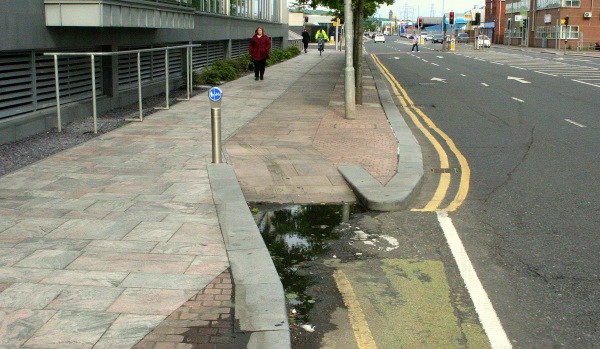
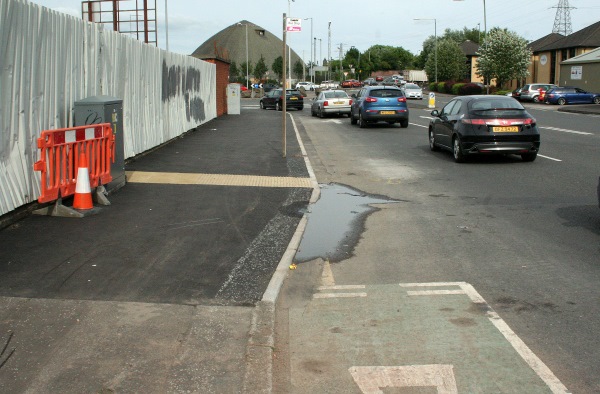
Not only do users have to contend with several transitions between shared and dedicated space, but those transitions themselves suffer from poor implementation. A lack of drainage is causing ‘perma-puddles’ to build up. As an occasional inconvenience perhaps not too bad, but the water sits for weeks at a time (even through dry spells, as in the picture) leading to murky, muddy pools gathering dirt and moss. People commuting to work risk getting clothes dirty, and chances of slips and falls are increased.

PermaPuddle1
Slippy perma-puddle on a transition ramp from road to shared footpath

Bad enough that one perma-puddle exists, but given that a new transition has just been created, lessons clearly haven’t been learnt.

PermaPuddle3
Second perma-puddle – transition has a treacherous raised kerb, and a bus stop sign

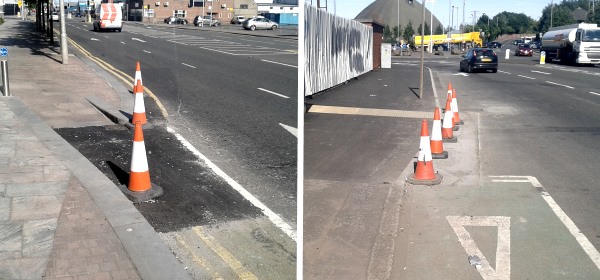
Updated 17th June 2014

Remarkably (planned) work has been carried out to attempt to fix the drainage issues, as seen on the way to Stormont during Tuesday rush hour:

Works

Hopefully this solves the drainage problems, and shows that Belfast Harbour are sensitive to the issues on this cycle route.

Belfast Harbour’s legacy wasn’t build on cheap solutions

Belfast Harbour is now firmly in the business of cycle route planning and design. If they deliver cycle space of a poor standard, it reflects badly on the neighbouring routes at Laganside and the Connswater Greenway, dragging down their potential too.

Over the long decades, generations of Harbour Commissioners and the industries and trade they’ve fostered have done things on a grand scale – city building, airplane manufacture, Hollywood film production, launching the most famous ocean liners in the world.

While NI hopes that DRD’s new Cycling Unit is learning from cycling infrastructure best practice around the world, the industry and output from Belfast Harbour has always sought to be world-leading. Why should the Harbour’s cycle space be any different?

That Sydenham Road chatter..

Fat Bloke On A Pushbike Blog: The Sydenham Road Cycle Lane – My View

https://twitter.com/individualjs/status/444838843062419456

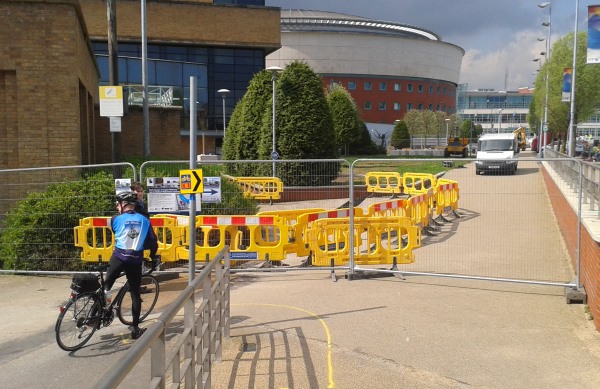
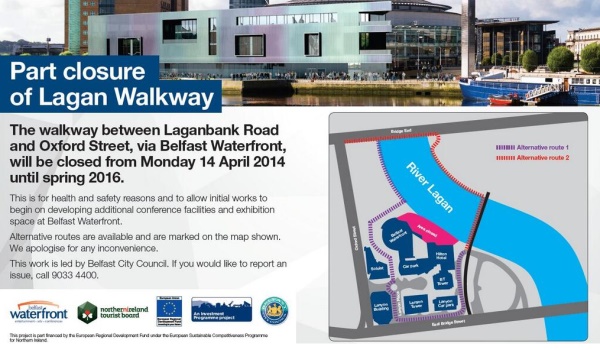
This week in Belfast, the western bank of the Lagan River Walkway closed for two years, to allow construction of a new Conference Centre at the Waterfront Hall. This path is the traffic-free walking and cycling spine of Belfast, part of the National Cycle Network, and crucial to the success of the city’s cycling revolution. So why isn’t the path being maintained through the works, and why are the proposed diversion routes not up to standard?

The Waterfront extension works were announced in January, part of a £29.5 million upgrade to attract international conferences and exhibitions. Disruption to the Lagan Walkway route was expected, as the new structure will overhang the pathway when completed. However, it’s understood diversions were decided before the main active travel body in NI, Sustrans, was consulted. So what were the options on the table for Belfast City Council?

Waterfront Hall barrier
Confusion and delay on day one, whether walking or cycling

Maintaining the route

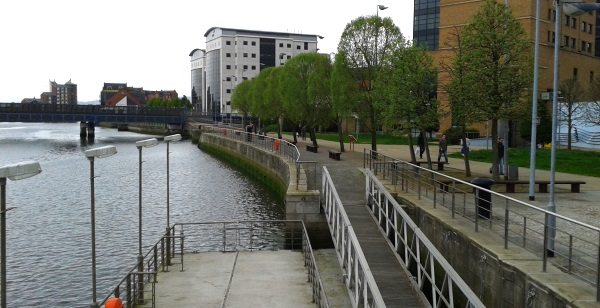
It’s understood that following initial works to the edge of the river, the substantive construction work will take place closer to the existing Waterfront building for a significant period of the next 2 years. Providing a boardwalk right at the river’s edge, or perhaps even a pontoon, seemed like a viable solution for continued access during periods of low risk.

Waterfront extension -  at the river's edge
Options here for a boardwalk to maintain the route?

The river’s edge at the Waterfront includes an existing pontoon for boat access and a built-out viewing platform. A clever engineering solution (still) seems possible.

Questions need to be asked of Belfast City Council: was it their own Health and Safety assessment which ruled out this option, or did the contractors just inform them it didn’t suit?

Alternative Route 1 (via Oxford Street)

Sustrans Ranger Ellen Murray knows NCN Route 9 very well, and has tackled the issue in great detail on her blog. She took a run along this diversion heading south to see the difficulties:

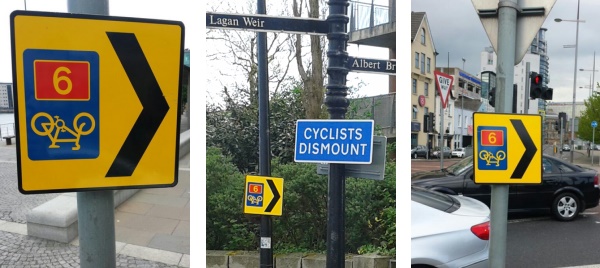
Signs for the 2 main diversion routes

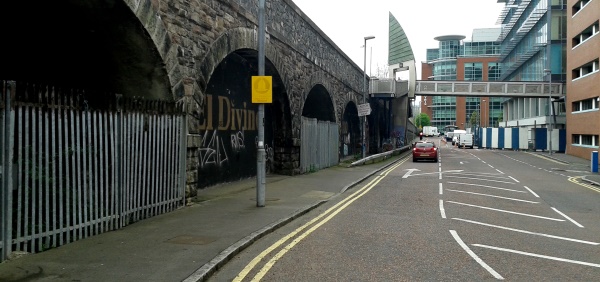
“This proposed route brings cyclists and pedestrians around the front of the Waterfront Hall, along a fairly ambiguous path which doesn’t feel like a contiguous route. It then brings users across a cobbled section (which is slippery when wet) across a minor roundabout, and then along a quite narrow stretch of Lanyon Place. The road is flanked on the left by a construction site, leading to poor visibility at corners.

Water5
Dark, unfriendly streetscape of Laganbank Road; pinched footways, ongoing construction

This road is also significantly below the level of the adjacent East Bridge Street and is an intimidatingly dark route after hours which feels very isolated, which is likely to further affect cycle and pedestrian traffic using the route.

Rejoining the NCN9 route at the ramp alongside the railway underpass presents a significant conflict area for pedestrians and cyclists, who need to turn more than 90 degrees to continue along their journey. Along the whole proposed route, there are many crossing points for pedestrians, and a significant number of conflict areas for cyclists and pedestrians, who will now have to contend with Hilton Hotel traffic at the roundabout, and other local traffic along Lanyon Place.“

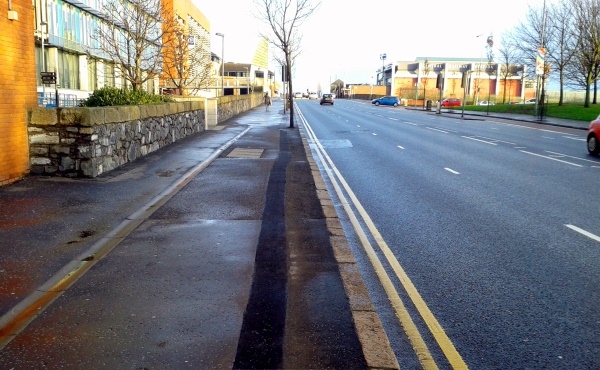
It also represents a significant detour, especially for those on foot. For anyone walking from the Albert Bridge or southern sections of the Lagan path, being diverted up East Bridge Street is a far more direct route, albeit with poor cycling connectivity to Oxford Street.

Better dedicated cycling facilities on East Bridge Street could have taken some of the strain during the next 2 years. Consideration should be given (as part of a developing cycling masterplan for Belfast) for a separate cycle path on the country-bound side.

EBSlane
#Space4Cycling possibly right under our noses on East Bridge Street?

Alternative Route 2 (The Bridges)

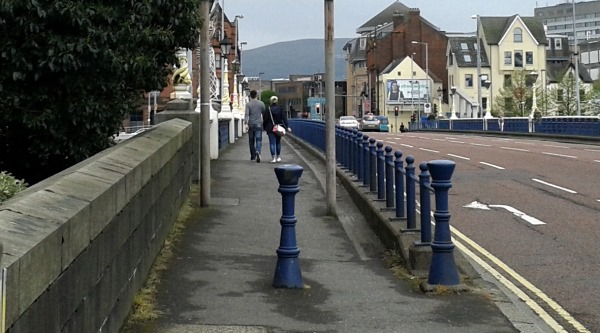
While a potentially shorter route, the mis-steps by Belfast City Council in rolling out this diversion have been amazing to watch. From first viewing of the map, you wonder if Belfast City Council ever bothered to check if cycling was legal on the tight, busy pedestrian footway on Queen’s Bridge.

QueensBridge
Cycling neither desirable nor legal on this busy bridge

Clearly, with the generous allocation of ‘Cyclists dismount’ signage (alongside the highly embarrassing upside-down route markers) the penny had dropped by the first day of route closure.

UpsideDown

Unfortunately the ‘Cyclists dismount’ signs then appeared on the shared use railway footbridge as well – thankfully with the intervention of Sustrans (following the tweet below) they were removed.

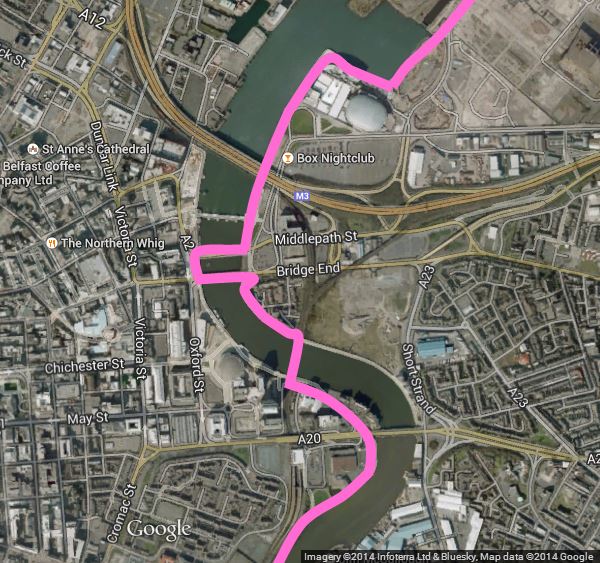
How much work did Belfast City Council put into considering users’ needs and journey modelling? Did anyone consider that a high percentage of users’ journeys might be towards Titanic Quarter, whether tourists, day-trippers or workers? From the south, the diversion sends bewildered users across the River Lagan fully 3 times to reach this area!

Route

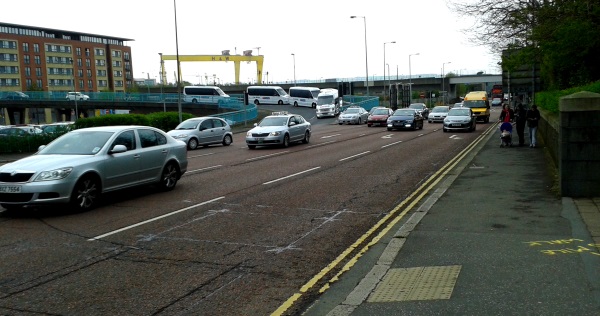
Looking at the map above, you might wonder why you need to cross two parallel bridges at all. The problem is the lack of a viable crossing – safe enough to allow pedestrians and cyclists of all abilities, people pushing prams, getting families (whether cycling or walking), those with limited mobility to safely cross four and a half lanes of fast, continuous traffic at Bridge End – as this video shows.

[youtube http://www.youtube.com/watch?v=QK56pVvzzoQ?rel=0]

This disconnect requires urgent action. One of the poorest aspects of this whole scheme is the failure to adequately cater for disrupted journeys by actually spending money on solutions. Other European cities with a keen interest in protecting and encouraging active travel make big gestures to accomodate cycling and walking through construction projects. The boardwalk idea may have its health and safety drawbacks, but has cost been a factor? Surely not within a £29.5 million project?

Similarly, Belfast City Council should be able to find roughly £60,000 to work with DRD to add a toucan crossing at Queen’s Bridge (as recommended by Sustrans). This would improve accessibility for the duration of the project, and leave a lasting legacy to the east bank of the Lagan. This is the most pressing and necessary option which Belfast City Council must pursue to salvage some pride from this sorry episode.

Queen's Bridge with Bridge End and Station St flyover traffic
Four (and a half) lanes of busy commuting traffic, no controlled crossing

In the same week (trebles all round at the Press Office!) Belfast City Council have announced the contractor to deliver the Belfast Bike Hire scheme, which should now be operational by next spring. That’s right – the closure of Belfast’s premier traffic-free path, and the associated mess, will still be happening at least a year into the operation of Bike Hire.

There’s a disappointing sense that the needs of people who use this route everyday, and the all-important visitors to our city, were an afterthought in Belfast City Council’s Waterfront extension project. They’ve misjudged the importance of the path. It’s a route for tourists, for leisure use, for commuters, for shoppers and much more. Belfast City Council should be encouraged for it’s investments, both in the Conference Centre and in active travel projects like Bike Hire. But they cannot afford further failure on the day-to-day basics of encouraging car-free travel.

* * * * * * * * *

Related tweets

https://twitter.com/GregorClaus/status/461942212021215233

https://twitter.com/GregorClaus/status/461928466221633536

https://twitter.com/ellenfromnowon/status/461421963899326464

https://twitter.com/ellenfromnowon/status/461176643118460929

https://twitter.com/chrismccorry/status/460468494069669890

https://twitter.com/ellenfromnowon/status/460202136178262016

Most days cycling in Belfast to work, to the shops or back home is uneventful. But then it’s Giro d’Italia year in Belfast and magic things are happening. Even a small section of a simple journey can hold remarkable sights within the space of a few hundred metres.

Continue reading “If only every ride home could be like this..”