In the first of a series of guest opinion pieces on cycling, Stephen McNally considers the difference between knowledge and action, rhetoric and actually road-mapping the end of car culture domination.
………………
“My cigarette is the mild cigarette, that’s why Chesterfield is my favourite” Ronald Regan
I started smoking in 1986. I was 16. Everyone smoked. My Da smoked. All my teachers smoked – in class, constantly. At 16 you could bring a note from your parents giving you permission to smoke in school. Friends smoked, brother smoked, girlfriend smoked. I started work at 18 in a local newspaper, I smoked at my desk. I could smoke on the bus to work. I could smoke on a train. I could smoke in a plane. I could smoke in a hospital. I could smoke in a bar. I could smoke in a restaurant. I could smoke in McDonalds. The Embassy World Snooker Championship was on TV. Snooker players smoked. Darts players smoked. Footballers smoked in dugouts and managers smoked on the touchline. Marlboro hung over the gantries in F1 racing, JPS, Silk Cut and Benson & Hedges plastered the cars and the drivers.
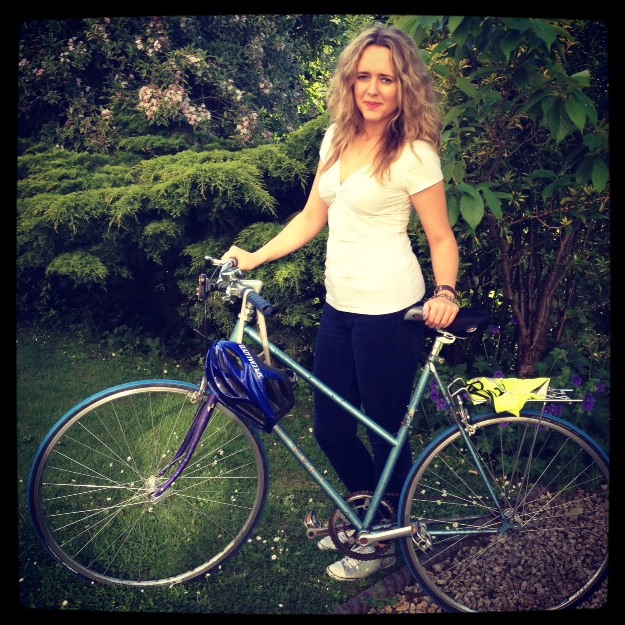
Kate is from Holywood, County Down and is a staff worker for the Alliance Party. She was a regular cyclist when living in London, but since moving back to work in Belfast she finds the road environment here too dangerous, and will rarely cycle the city..
I first learned to ride when I was 5 🙂 but I’ve been cycling properly since about 2008. I own a fixed-gear road bike which my sister and her boyfriend built for me. Cycling is popular within the family, my brother does the occasional lycra-hill thing, but I don’t know how regular that is! My sister is the real cyclist in the family, she even had her own bike building company in East London at one point.
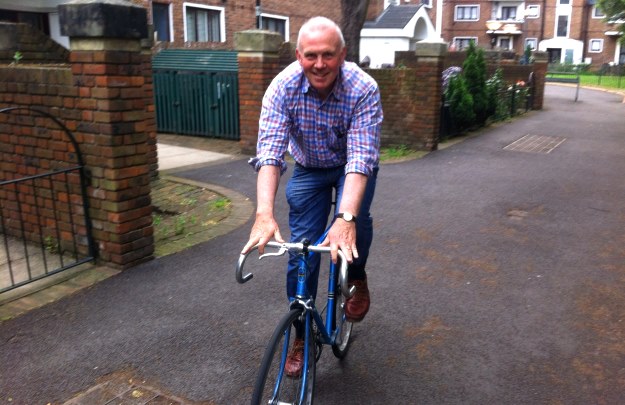
John Kyle is a 61 year old GP and has been a Belfast City Councillor for just over 6 years. John talks about his love of cycling which gets him out for leisure and between his places of work..
I’ve cycled all my life, but more so the past 10 years since my knees decided they had had enough of jogging. I cycle partly for health reasons but I love the freedom cycling gives you, the sense of speed, the proximity to nature – you see so much more than when in a car. I really love the buzz I get from physical activity, and definitely love being able to bypass traffic jams.
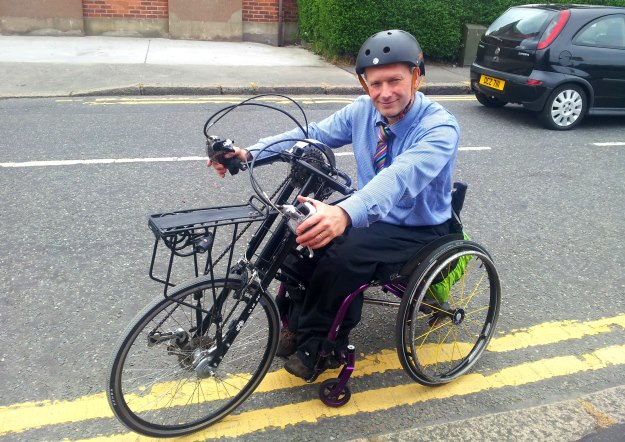
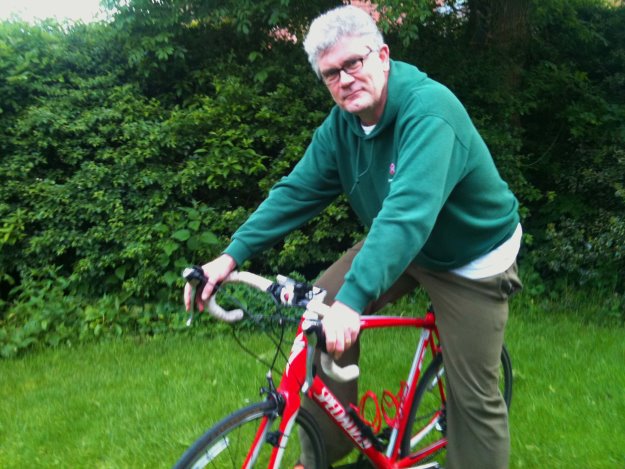
Diarmuid is a teacher at Grosvenor Grammar School in Belfast, a father of 3 and a wheelchair user for nearly 30 years. He talks about how handcycling has revolutionised his daily routine to the point where he’s sold his own car. His unique experience of travelling around Belfast challenges many myths about cycling as a viable form of transport, for people of all abilities..
While in university in 1984 I suffered a spinal injury in a hill walking accident. I was at university preparing to go into teaching, so I was lucky that after taking a year out the adjustments I had to make in life didn’t throw me off my career path. I’ve been teaching in Grosvenor Grammar School in Belfast for about 20 years now. It’s really encouraging to see Grosvenor trying to get a cycle to work scheme organised for the staff.
The rise of cycling in Belfast is a welcome sign of public understanding of the flexibility and reliability of the bicycle. But scratch beneath the surface and the classic signs of a poor city environment for cycling are clear. Riding a bike is a non-exclusive activity, open and beneficial to everyone. But Belfast commuter cycling appears to be male-dominated, judging by numbers seen riding each day. What is the reality?
As part of Bike Week, local people who cycle our streets share their stories, fears and hopes. Tony, originally for Omagh but a long-time resident in Glengormley, is one of the Pro Vice-Chancellors at Queen’s University Belfast (QUB), looking after planning, staffing and external affairs for the University. He explains his passion for cycling for transport and leisure..
I’ve been cycling for about a decade, and own a touring bike, a mountain bike and a road bike. I use the road bike most of the time, but occasionally take the mountain bike for a spin around Cavehill. I have 4 daughters, 2 of whom cycle fairly regularly, though one has been curtailed since her bike was stolen. Apart from the bicycle I use a motorbike – I’ve never driven a car and have no plans to start.
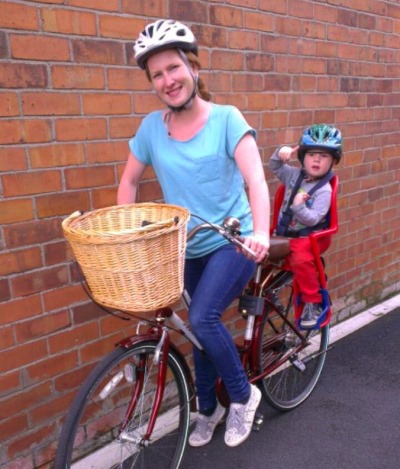
As part of Bike Week, local people who cycle our streets share their stories, fears and hopes. Kelly from Belfast gives her experience of cycling the school run with her children and how, despite less than ideal routes and road conditions, cycling has simply become part of life..
I own a couple of bikes – my old faithful mountain bike which I’ve had for a long time, and last year my husband bought me a ‘Real Classic’ bike for my birthday. It’s a modern bike with a vintage styling and I love it. It’s a thing of beauty as well as being practical. I have a child carrier on the back for my youngest son, and he adores it. It also has a basket on the front which makes it really handy for trips to the shops. I’ve cycled for fun since I was a child, but have cycled as a means of transport since my university days, 12 years ago.
My main cycle route tends to be to the school and back. My oldest two children, who are 7 and 5, ride their own bikes and I take my 3-year old on my bike. We are fairly fortunate in that we don’t have too many roads to cross, but because we are cycling at busy times of the day we tend to stick to the footpaths as it’s just far too dangerous for me to take them on the roads. There’s no way I could cycle safely myself and supervise them on the road at the same time.
The kids love it
As I’m sure is the case for most families, life is busy, so getting time to exercise outside of the day to day routine is tricky, so we made a decision a while ago to try to stay fit and healthy as a family. I see the school run cycle as a form of exercise for me and the kids but it is also something we really enjoy. We get a lot of enjoyment from being outdoors together and I believe they are learning valuable skills on road safety and physical well-being during our cycles.
We tend to cycle for leisure at the weekends and during summer holidays too. It’s a free activity during a long summer break, which is always a bonus and the kids love it. Even if it’s just a cycle to the local park for a play, we always feel great after a bike ride and less guilty when we stop for ice cream!
We do have a car – I wouldn’t expect the kids to cycle to school in the rain, as they would have to sit in school all day with wet clothes, but if it’s dry, we are out on the bikes. We will even cycle to the shops if we are only getting a few items. They love getting to lock up their bikes at the bike racks – it’s all part of the adventure for them!
For the most part our cycling is enjoyable, and something I think we will always endeavour to do. People always smile when they see the kids out on their bikes with me, and my own bike has been a great source of admiration for the other mothers at school. I’ve even seen a few other mums cycling over the past few weeks as the weather has improved and I think that’s great.
I am wary of road cycling
I did have one ‘run-in’ with a pedestrian on the morning school run. He was walking his 3 dogs and one of my sons rang his bell to alert him that we were on the footpath behind him. The man turned abruptly and shouted at me and the kids that we should be on the road and not cycling on the footpath. The children were very upset to see their mum being shouted at and I felt very intimidated but did try to explain that there was no way I could cycle on the road with children so young. There are no cycle lanes around the school and the area is very busy with traffic. The irony was that as he was busy shouting at me, one of his dogs ran onto the road and the traffic had to halt. So in actual fact he was the one causing bother. I hope he had a pooper-scooper now there’s a real issue on our streets!
As the children get older, I know I will have to educate them on cycling safely on the roads. I am wary of road cycling myself though, as so many of the cities cycle lanes are blocked with parked cars. I also have a few friends who cycle as a means of transport much more than I do and when I hear some of their horror stories – bins blocking city centre cycle lanes, aggressive bus drivers, oblivious car drivers almost squashing them – it puts me off a little I must admit.
Cycle lanes should always be kept clear
At the moment, my cycling is limited to a very small area. Mainly because my children are so young and can’t go too far, but also because I am apprehensive about negotiating roads. If we want a longer cycle we tend to put the bikes in the car and drive to a cycle path and then we can cycle with a bit more ease, although sometimes our slow pace irks the more adept cyclists. That doesn’t really bother me, the way I see it, we all have to start somewhere and build on our abilities.
I suppose one thing that might be useful is to educate drivers when they are learning on how to be more aware of cyclists and how to be respectful of all road-users. Drivers can often think they have more right to be on the road, and on other occasions they are completely oblivious to the bike that is alongside them. Cycle lanes should always be kept clear, and I do feel that this should be policed in some way, particularly in city centre areas where it is so busy.
Overall I would say that cycling is just a part of life for us. I hope that as the kids grow up they will continue to have a passion for cycling because of what they have experienced in childhood. It would be great to see more families out and about cycling and to know that it was something families could do together safely in their own towns.
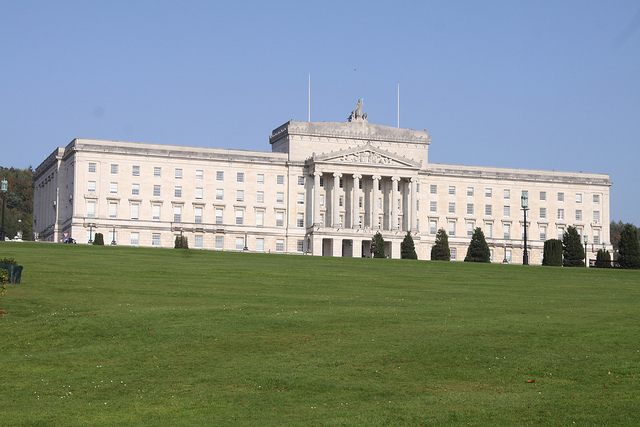
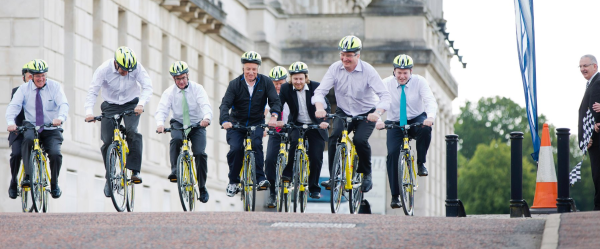
Bike week is upon us! It’s that time of year when the Regional Development Minister and various politicians are handcuffed to bicycles and horsewhipped around the Stormont Estate for their annual photoshoot. Delve into government and political press releases, articles and interviews and you’d be forgiven for thinking Northern Ireland was an international beacon of active travel. Millions of pounds have flowed into making cycling easy and safe, increasing journeys is a high priority, obesity must be tackled…and so on..
And what of the other parties in Northern Ireland? Brace yourself for an onslaught of free and easy statements of support, but judge for yourself the context. Policies and priorities are in a constant state of change, and interesting developments may be happening behind the scenes. But your political parties represent you on the basis of a mandate from the Assembly elections just 2 years ago. Was cycling (and by extension active travel) important enough to reach party manifestos in 2011?
In Northern Ireland, 28% of all journeys less than one mile and 67% of journeys between one and two miles are made by car. Alliance supports the continued provision and maintenance of cycle lanes on our roads. We recognise the importance of safe road use. In particular, we believe there is a need to educate children in the safe use of roads. We therefore propose primary schools include cycling proficiency as part of the physical education curriculum.
Continue to minimise road casualties through road safety engineering, collision remedial schemes, traffic calming, school safety zones and improved pedestrian and cycle networks.
Increase the number of regular cyclists. [Tackling obesity]
Introduce measures to give pedestrians priority in residential streets, including a 20mph speed limit in built-up areas.
Ensure most children are able to walk or cycle to school and support employers who promote cycling to work. Giving the highest priority to safe routes to so that most children are able to walk or cycle to school.
Encouraging all other initiatives to incentivise a change of travel mode to cycling – including alterations to allowances paid by employers to their employees for their necessary travel and government tax relief for work related cycling on a scale no less generous than car allowances.
However, going forward there must be a fundamental shift in the spending balance in order to address the inadequate provision of alternatives to car use and make sustainable, accessible, value-for-money transport the first choice for the people of this region.
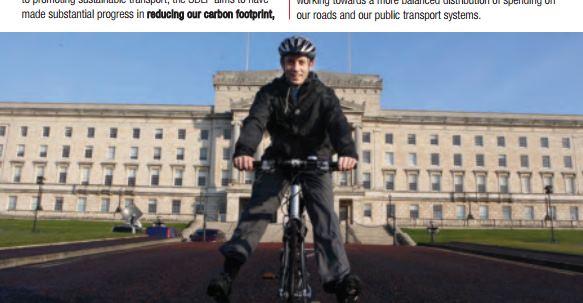
It is widely accepted that reducing the speed from 30 mph to 20 mph on urban residential streets through creative urban planning has been proven to increase the number of cyclists on the roads. The SDLP therefore brought draft legislation to the Assembly which would reduce speed limits in urban areas. By making our streets a safer place for all, we will increase uptake of active transport, namely cycling and walking.
Image from SDLP 2011 Assembly Election manifesto
We initiated the draft legislation and also demanded a reversal on cuts to the active transport budget following the startling 98% cut in the Budget. In the next mandate, we will build on our work to date by expanding and promoting the ‘bike to work’ scheme to encourage employees to cycle to work if and where possible, incentivising the scheme by enabling employees to purchase bikes tax-free.
In addition, we will establish a bike scheme in Belfast, whereby bikes are available for short-term public hire across the city, given the success of a similar scheme in Dublin, as well as evidenced in many cities across Europe. Looking beyond our main cities, we support the expansion of the cycle network across the North and an increase in the number of dedicated cycle routes.
(Although UKIP did not contest the 2011 Assembly Elections, they have since absorbed and assimilated David McNarry MLA, late of the Ulster Unionist Party. As well as gaining NI’s first UKIP MLA, this gave UKIP a voice on the Regional Development Committee, and therefore immediate influence on transport policy. The closest manifesto and policy for this comparison was the General Election of 2010.)
Support responsible pedal cycling but have zero tolerance on dangerous practices such as running red lights. We will consult on proposals for cyclists to display a cheap ‘Cycledisc’ to deter theft and give 3rd party insurance for car damage.
Improve safety that will reduce the number of people killed or seriously injured on our roads and encourage the use of more sustainable forms of transport including public transport and cycling and walking.
The Programme for Government 2011-15
The Northern Ireland Executive (made up of Ministers from DUP, Sinn Féin, Alliance, UUP, SDLP) agreed a Programme for Government to cover the Assembly term. The only implied and explicit mentions of cycling were:
Invest over £500 million to promote sustainable modes of travel (DRD)
By 2015 create the conditions to facilitate at least 36% of primary school pupils and 22% of secondary school pupils to walk or cycle to school as their main mode of transport (DRD)
Looking ahead to the next election
A great deal of work is needed between Bike Week 2013 and the next Northern Ireland Assembly elections in 2016. Cycling organisations have a role to play, but ordinary people – citizen cyclists – must act to see detailed and stretching ambitions locked into all party manifestos. If we look to Scotland and the Pedal on Parliament campaign, we can see inspiration for a set of goals for Northern Ireland which should be pressed for in the run-up to 2016.
NI’s Executive looks set to continue as a multi-party coalition for the foreseeable future. This means any of the main parties could choose Regional Development under the D’Hondt system. Also, the Programme for Government priorities are agreed between all Executive Ministers (and parties), so having everyone singing off the same hymn sheet before the elections is half the battle.
Cycling as an issue doesn’t fit with the traditional voting patterns in Northern Ireland. It cuts across religious or community identities, but in itself will not be likely to influence voter choice as a single issue. Working to ensure that all political parties include headline policies to ensure funding, strategies and targets for cycling is the most likely route to success. Your work begins this Bike Week.
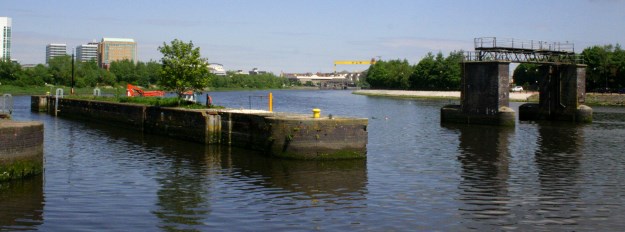
Belfast is in the middle of a mini active travel boom, mainly driven by rising numbers of bike commuters. But Belfast suffers from structural issues which hold back cycling development, not least the physical barrier of the River Lagan. One plan to provide relief, a new pedestrian and cycling bridge linking the Gasworks site to Ormeau Park, has been largely forgotten. Why?
The Gasworks Bridge would span 140m between the Lagan entrance to the Gasworks Site and the Ravenhill Reach car park beside Ormeau Park. The project cost is estimated in the region of £4million to £8million. The benefits to the city have been clear for many years:
greater access for people in South and East Belfast to the city centre
making Ormeau Park a city centre park, accessible by both residents and workers, 15 minute walk from City Hall
provide safer pedestrian and cycling options than Albert Bridge and Ormeau Bridge
increase in walking and cycling with the health, leisure and transport benefits
further encouraging inner city regeneration with a new signature city gateway
This would be the first standalone bridge to be built in Belfast solely for cycling and walking journeys – an important signal of intention to follow through on active travel promotion. Local residents surveys have always returned positive views, with few concerns about potential interface issues. All very positive, but it seems to have dropped off the agenda.
View from Ravenhill Reach looking down Gasworks / Ormeau Avenue corridor
Adding the bridge would open up east-west journeys on the National Cycle Network, increasing the potential of the Gasworks Park pathway which links almost directly into the city centre. The Gasworks Park hosts large employers like Lloyds and the Northern Ireland Environment Agency, but also the Radisson SAS Hotel. The bridge would not only be a commuter and lunchtime leisure option, but also a tourist facility.
For walking journeys to work, Shaftesbury and Botanic wards lead the way with over 40% of commuter ‘traffic’ on foot. Yet just across the river there is a sharp drop-off with Woodstock and Ballynafeigh wards around 25% and Ravenhill less than 20%. Physical disconnection is at least partly responsible, with long diversions needed to reach the main employment base in the city centre.
Commuter cycling share in wards surrounding Gasworks bridge (Census 2011)
A startling 51% of households in Woodstock have no access to a car or van (Census 2011) over double the rate of Northern Ireland as a whole. Direct traffic-free access into the city centre is both desirable and necessary here.
Belfast has seen a 60% rise in cycling commuters between 2001 and 2011. If a Gasworks Bridge contributed to a doubling of cycling levels in these top 3 wards by 2021, cycling levels would outstrip even bus commuting here, which begins to fundamentally change the inner city transport dynamics.
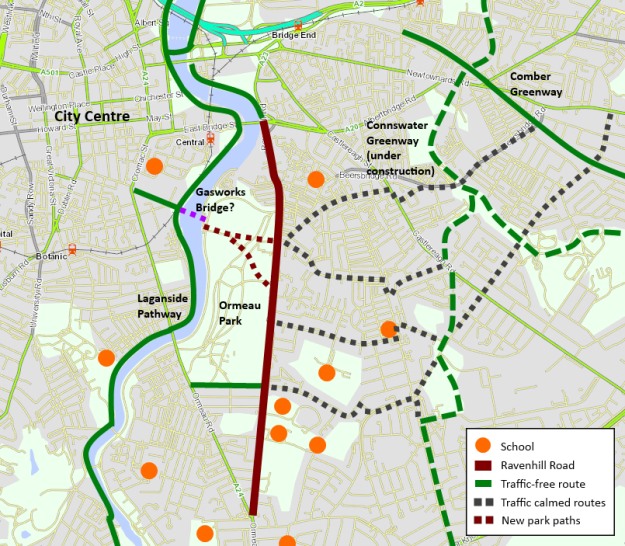
By upgrading cycling routes beyond Ormeau Park, across traffic-calmed residential streets towards Cregagh and Castlereagh Roads and the two Greenways, a genuine and attractive alternative to car travel becomes possible for a large part of South East Belfast. A positive impact on inner city traffic levels must be considered a key element of the bridge’s benefit.
What are the alternative cycling commuter routes?
The existing connections between the city centre and the suburbs of South and East Belfast have become scenes of cycling commuter stress and conflict. The area is poorly served by just two main access points across the Lagan a mile apart, the Ormeau Bridge and the Albert Bridge.
The Albert Bridge in Belfast, a major barrier to cycling uptake in East Belfast
Planners have had their eye on a bridge here for decades, but not always for a footbridge. In the rush to build for a motorised future, 1960s plans foresaw an urban motorway running around the Gasworks site and over to Ravenhill. While the motorway plan thankfully fell away in the 70’s, the idea of a more modest distributor road bridging the Lagan and running to the Ravenhill Road lingered through to the 1990s. Along with the main plan for a southern inner ring road, currently in limbo, this has contributed to urban blight through restricted development along the Bankmore corridor.
Bankmore Street, effectively abandoned to a road scheme that never happened
Lately with the recognition that a road scheme would not be viable or attractive, and the redeveloped Gasworks site opening in 2001, the idea of a traffic-free bridge moved up the agenda. Boosted by the inclusion in the Belfast Metropolitan Transport Plan 2015, it seemed obvious that the bridge would be built quickly, given the success of the wider Gasworks and Laganside projects:
“Two new pedestrian/cycle bridge crossings are proposed to serve key activity spines between the east and western sides of the River Lagan. These will improve the connection between the extension of existing riverside walkways and the more strategic sections of the pedestrian network. These bridges will be funded as part of the regeneration of Belfast.”
Department of Regional Development (DRD) – NI transport planning and infrastructure, including active travel
Lots of interested parties, but no-one to take a clear lead. It was unfortunate timing that the Laganside Corporation was wound up within 2 years of this, having reached £1 billion of investment in the city.
If we’re relying on a 140m river crossing to be a transformative factor in community relations and breaking down sectarian divisions, what hope is there for Northern Ireland? EU Peace funding has been practically ruled out, and the reason is clear when you cut through the ‘additional’ benefits and set out the purpose of the bridge in basic terms:
The project’s most important function is to provide a new transport corridor in Belfast.
Therefore it falls squarely within the remit of DRD and their executive agency Roads Service. A Belfast City Council Development Committee report on the potential construction and maintenance of the bridge from back in 2005 shines a troublesome light on DRD active transport thinking:
“It is obvious that responsibility for the project should be taken up by Roads Service. Initial contact with Roads Service has however been met with a lukewarm response despite the rhetoric in the BMTP etc in regard to walking and cycling as valid means of transport.”
Can DRD to demonstrate they have moved beyond this point, and take ownership of a major project exclusively for active travel? Is there a golden window of opportunity given the ongoing difficulties with the A5 road project?
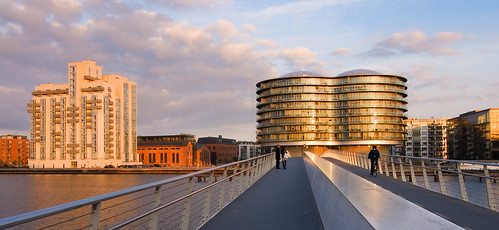
For an international comparison, Copenhagen is one of the leading cities in the world for urban cycling, with a journey share of around 36%. But it’s a city still trying striving to improve, and leading this charge with urban bridge building for non-motorised traffic with the Copenhagen harbour bridges project.
Bryggebroen cycling and pedestrian bridge in Copenhagen
The Gasworks Bridge is a key element of re-imagining and reworking central Belfast. Council plans are afoot for sweeping regeneration from the Markets area to Sandy Row and Shaftesbury Square. The bridge would open up new possibilities for commuting, leisure, shopping and social trips that aren’t really viable today. It’s easy to overplay the significance, but the bridge even has the potential to help boost the evening economy in the city.
The Gasworks Bridge is a key part of the Belfast Metropolitan Transport Plan 2015, which is still used to determine capital project priority in the current budget period. If the DRD Minister should wish to leave a legacy for Belfast which provides positive encouragement to reduce car journeys, he would struggle to find a better opportunity than the Gasworks Bridge. .
[youtube http://www.youtube.com/watch?v=GtjBjgHkAAM?rel=0]
What do you think about the idea of a Gasworks Bridge? Will it encourage you to ditch the car? Comments are open below..
*** UPDATE *** 20th June 2013 *** UPDATE ***
A week is a long time in politics, and one week on from this post there is stunning news. Regional Development Minister Danny Kennedy, while addressing the Politically Painless Active Travel conference in Belfast, announced he is to commission a feasibility study into the Gasworks Bridge project!
This is great news for the local community, active travel organisations, councillors and many others who have put in the real work over a decade to see this bridge built. Hopefully DRD / Roads Service will make swift progress, and the project’s overwhelming benefits will ensure a positive outcome. The potential to transform this part of Belfast is immense – with Belfast cycling on the rise, it seems the Gasworks Bridge’s time has come!
With the Gasworks Bridge back on the agenda for Belfast, regular cycling may become a serious transport option for many people in southeast Belfast. Yet the current barriers to cycling must be overcome to extract maximum benefit for the people of Belfast. The Ravenhill Road may become the focal point to set a new Belfast standard for designing roads for people, not vehicles. By looking at best practice from the Netherlands, a simple plan can be set out to revolutionise the experience of cycling in Belfast, and provide the backbone for a new high density active travel network.
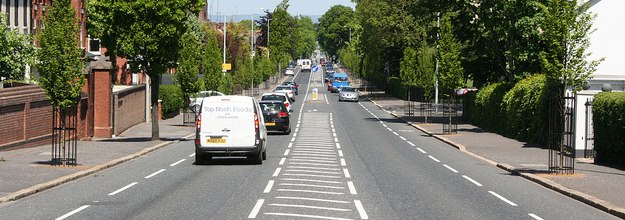
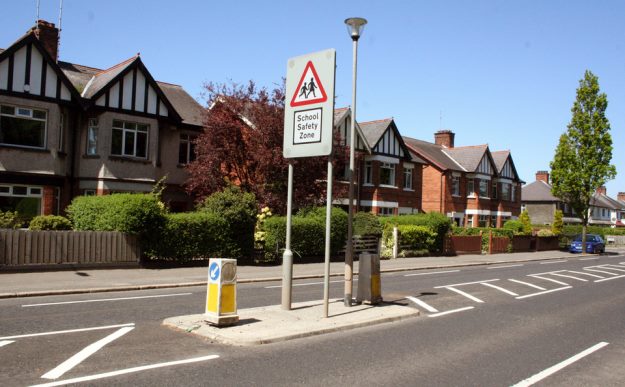
Ravenhill Road layout at Cherryvale Park entrance, central island dominates the road
Ravenhill is a ‘B’ road which suffers from being the most direct route between the northern and southern sections of Belfast’s ring road. Yet it’s also a narrow, leafy residential road, with two major parks, large schools and a handful of locally-focused businesses – a quiet backwater in contrast to the bustling parallel Ormeau and Cregagh Roads.
It also runs through the highest density of cycling commuters in Northern Ireland, with around 5% of residents from Ormeau to Cregagh choosing to regularly bike to work. Yet there is little evidence of a wider cycling culture here outside of the typical commuter profile. The current advisory cycle lanes send out the message that cycling is for commuters only, and contributes to the unhealthy gender profile of Belfast cyclists.
To open up journeys to everyone – young and old, men and women, families, shopping trips, leisure rides, all day and night – needs a tried and tested simple solution, dutch-style separation. If your instinct says this is too radical for Belfast, you might be surprised to know an example of high quality separation is just 200 metres away.
Planning for the Ravenhill Road to become an important link in many journeys between suburbs and centre, and between parallel greenways, requires 3 simple steps.
Separation
Whether through lack of funding, commitment or vision, Belfast’s cycle network has been allowed to develop as a series of disjointed on-road lanes. Worse still, they are designed around the needs of motor traffic – exceptional at keeping cyclists out of the way of cars, vans and trucks in higher speed sections where conflict isn’t necessarily an issue, and removed when cyclists’ needs are greatest, at junctions and roundabouts.
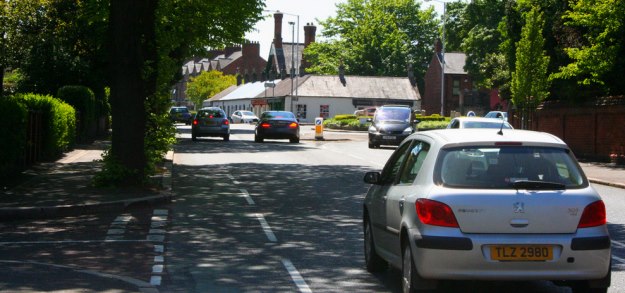
Predictably the cycle lanes disappear at the approach to the Ormeau Road roundabout. Less forgivable is the disappearance at the other end of the Ravenhill Road, solely to cater for traffic using a major city rat run at My Lady’s Road (see video).
The issues with advisory cycle lanes in Belfast are well known to readers of this blog, and the Ravenhill Road has featured on the Reclaim Belfast’s Cycle Lanes two surveys. Each side of the road has an urban clearway for 1.5 hours each weekday, which means for 96% of the week parking is perfectly legal; these spaces cannot truthfully be described as “cycle lanes”.
The following video shows how the quiet adjacent Park Road has a high quality separate lane, while the busier Ravenhill Road has much poorer facilities in comparison.
Paint on the road will not encourage parents to let children ride to school alone, parents to take small kids to nursery on bikes, those too afraid to cycle into the city centre to work, or for short trips to the shops. This approach has delivered little more than 2% of traffic on bikes across Belfast. It’s time to take a bold step – redesign a major road with fully separate cycling infrastructure.
Redesigning Ravenhill Road
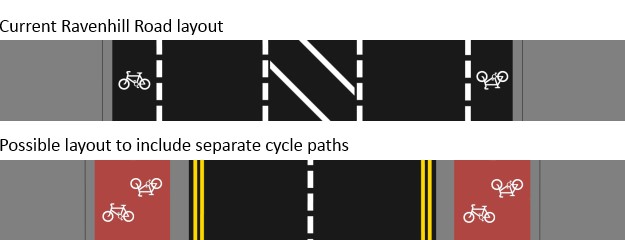
The current road layout is quite standard for Belfast, with:
a fairly consistent 16.5m span
roomy footpaths
on-road advisory cycle lanes
2 traffic running lanes
a central island lane running almost the full length to aide turning movements
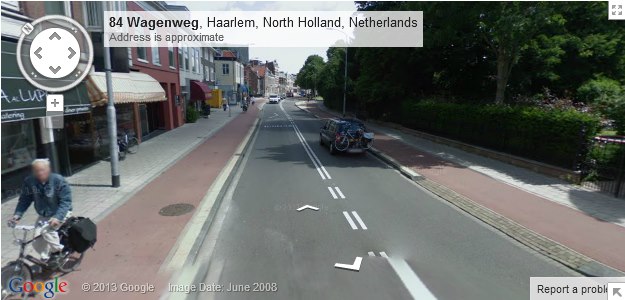
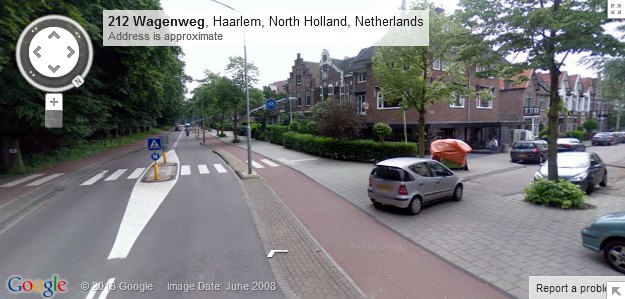
Taking inspiration from Haarlem in the Netherlands, a reworked configuration would see the central island lane removed. Two running lanes are retained at approximately 3 metres each way, with 2 metre footpaths and 2 metre cycle tracks with a standard 0.5 metre kerb separation from the carriageway.
Separation benefits cyclist not just through actual safety and the perception of safety, but also removes limitations of being part of traffic. Short side road to side road trips are possible on a two-way cycle track on either side of the road, allowing many children to cycle to school without having to cross a road to join traffic.
Balanced roadspace allocation in Haarlem on similar road footprint
What about the tough places where the cycle lanes disappear? Again the Netherlands have decades of experience when it comes to junction design. The Ormeau Road roundabout may be jealously guarded by road engineers, but the Park Road/Ravenhill Park junction is ripe for a Dutch-style experiment, and the Ormeau Embankment junction could benefit from a southbound pass-through lane and better separation on the other approaches.
The loss of right hand turning boxes may be the most controversial suggestion, but consider how Roads Service balance the needs of all roads users with this central island. Running between Ravenhill Avenue and Rosetta Park (1.8km) there are 22 turning spaces for vehicles, compared to just 7 pedestrian crossings, and only two of those give pedestrian priority (pelican crossings). Vehicle needs and safety trumping those of vulnerable road users.
For the majority of desire lines (at more than 20 side roads and paths) there is no direct crossing, so people are forced to wait for a break in the traffic to cross, or make a long diversion.
Creating a series of zebra crossings on the redesigned road to cater for more pedestrians and cyclist crossing is essential. The needs of through-traffic from the south of Belfast and beyond to the city centre must be placed second to the needs of local users, especially those walking or cycling the school run.
In rural areas the right hand turning box is primarily a safety feature. In a 30mph urban/residential road it is there to enable the efficient flow of traffic around turning cars. It’s time to consider whether high average traffic speed should be the goal of urban road design, especially if it suppresses other transport needs and more liveable streets.
Side streets
The success of cycling in the Netherlands isn’t solely about separation. There is the understanding and empathy fostered by virtually the entire population cycling, and sustainable safety principles governing all aspects of design, not least at junctions and side roads.
Looking at the example below, cycle tracks and footpaths continue across side roads, giving priority to the more vulnerable users, but also a strong visual cue that you’re entering a different classification of road, and the sense of needing to adjust speed.
How side road access could be reworked on Ravenhill and pedestrian crossing example
You might think road regulations won’t allow for such a design in Northern Ireland; you may not be right.
The rat run at My Lady’s Road is a blog post in itself for another time, and London Road and Ravenhill Avenue don’t suffer from particularly heavy traffic flows – traditional calming methods could be easily deployed to discourage through-traffic.
Conall McDevitt’s 20mph Bill will be debated in the Assembly in the Autumn, and is understood not to be supported by the Department for Regional Development. Blanket 20mph limits on the residential streets here would be a great boost to active travel.
Ravenhill Park
To develop a high quality east-west cycling corridor with Ravenhill Road as the axis requires one major piece of road management. Linking the Connswater Greenway at Cregagh to the Ormeau Park and Lagan Towpath is possible by creating a traffic-calmed route along Ravenhill Park.
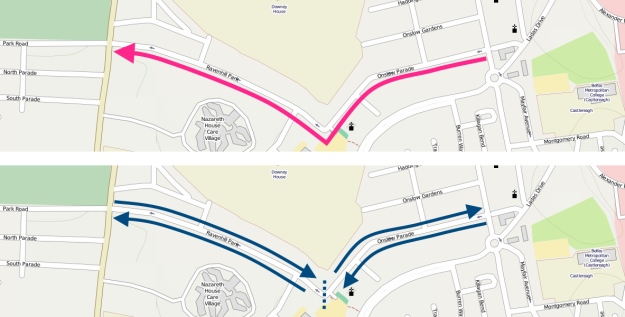
At the moment Ravenhill Park is one-way going west, which makes it a fast popular rat run route for traffic trying to reach the Ormeau Road from East Belfast. It’s also an unnecessary barrier to eastbound cycling journeys using the Park Road cycle lane – even (illegal) footpath cycling against the traffic isn’t possible due to high kerbs.
A simple, if radical, solution would be making Ravenhill Park and Onslow Parade 2-way again, but placing a barrier to vehicles beside Ravenhill Rugby Ground – removing all through traffic, calming speeds to solely residential users, and opening a new cycling corridor. Retractable bollards would be an ideal solution to allow fully flexible traffic management for Ulster Rugby matches and events at the new Ravenhill Rugby Ground. The Onslow side has a natural cul-de-sac turning circle at the stadium, and the nearby Ravenhill Park Gardens junction could provide a similar function on the park side.
Eastbound rat run traffic is unlikely to divert to Ardenlee Avenue, reverting to the more suitable Mount Merrion corridor. Westbound traffic wishing to use Park Road and Ardenlee as a cut-through from Ormeau to Cregagh can be discouraged by the lack of right turning boxes, changing the design of Ardenlee to a more residential style with raised entrances and cycle track priority, and further traffic calming.
Ormeau Park cycleways
Ormeau Park actually creates a minor barrier to the success of the future Gasworks Bridge. To be a truly transformative active transport corridor, new cycleways across the park, with lighting for the winter months, would be needed to for the most efficient journeys.
The lack of a bridge over the Lagan means there are no direct ‘desire line’ paths going east-west across the park. The ‘cage gate’ entrances designed to discourage cycling and prevent motorcycles accessing the park must be replaced with a better solution.
Belfast City Council’s parks opening hours (7.30am in the morning until sunset, as early as 5pm in the winter) would also cut into a large portion of homeward ‘rush hour’ and the potential to drive citybound evening economy journeys. Diverting people around the park would make the corridor and cycling less attractive. Ormeau Park would need a new 6am to midnight year-round policy.
Re-imagine Belfast and demand better
The potential Gasworks Bridge opens a range of possibilities and the chance for new thinking on how to move people around Belfast. Our streets are dominated by vehicles, but this is as much down to road design as to personal preference. Ideas and discussion are important to changing mindsets and building the space for active travel. In a city with rising congestion, falling car ownership, troubling levels of obesity and a more dangerous environment for cycling, tacking little bits of advisory cycle lane onto intimidating roads is no longer an acceptable waste use of public money.
Northern Ireland must learn from and implement best practice from the Netherlands for how to develop the safest and most attractive cycling space. This is how London is approaching its cycling vision, and Belfast realistically has an opportunity to lead the United Kingdom in cycling uptake, given the natural advantages for cycling. Belfast Bike Hire, the Giro D’Italia, rising commuter levels, the Gasworks Bridge – the stars are aligning for something truly special to happen in our city.
Give the people safe space to cycle and they will choose to do so in droves. Continue to pretend that Belfast’s roads are fit to promote as an genuine active travel option and we will all lose.